


Page 96 - JCBP-2-4
P. 96
Journal of Clinical and
            Basic Psychosomatics                                                 Psychopathology of COVID-19 patients


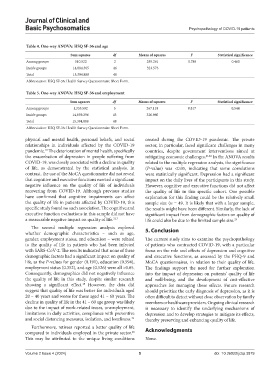
            Table 4. One‑way ANOVA: HSQ SF‑36 and age
                               Sum squares       df         Means of squares      F           Statistical significance
            Among groups         510.522          2            255.261           0.789              0.460
            Inside groups       14,884.365       46            323.573
            Total               15,394.888       48
            Abbreviation: HSQ SF-36: Health Survey Questionnaire Short Form.

            Table 5. One‑way ANOVA: HSQ SF‑36 and employment
                               Sum squares       df         Means of squares      F           Statistical significance
            Among groups        1,335.592        5             267.118           0.817              0.544
            Inside groups       14,059.296       43            326.960
            Total               15,394.888       48
            Abbreviation: HSQ SF-36: Health Survey Questionnaire Short Form.

            physical and mental health, personal beliefs, and social   created during the COVID-19 pandemic. The private
            relationships in  individuals affected by  the  COVID-19   sector, in particular, faced significant challenges in many
            pandemic.  The deterioration of mental health, specifically   countries, despite government interventions aimed at
                    16
            the exacerbation of depression in people suffering from   mitigating economic challenges. 21,22  In the ANOVA results
            COVID-19, was closely associated with a decline in quality   related to the multiple regression analysis, the significance
            of life, as demonstrated by the statistical analysis. In   (P-value) was <0.05, indicating that some correlations
            contrast, the use of the MoCA questionnaire did not reveal   were statistically significant. Depression had a significant
            that cognitive and executive functions exerted a significant   impact on the daily lives of the participants in this study.
            negative influence on the quality of life of individuals   However, cognitive and executive functions did not affect
            recovering from COVID-19. Although previous studies   the  quality  of  life  in  this  specific  cohort.  One  possible
            have confirmed that cognitive impairments can affect   explanation for this finding could be the relatively small
            the quality of life in patients affected by COVID-19, this   sample size (n = 49. It is likely that with a larger sample,
            specific study found no such association. The cognitive and   the results might have been different. Similarly, the lack of
            executive function evaluations in this sample did not have   significant impact from demographic factors on quality of
            a measurable negative impact on quality of life. 7,17  life could also be due to the limited sample size. 23
              The second multiple regression analysis explored
            whether demographic characteristics – such as age,   5. Conclusion
            gender, employment status, and education – were related   The current study aims to examine the psychopathology
            to the quality of life in patients who had been infected   of patients who contracted COVID-19, with a particular
            with SARS-CoV-2. The results indicated that none of these   focus on the role and effects of depression and cognitive
            demographic factors had a significant impact on quality of   and executive functions, as assessed by the PHQ-9 and
            life, as the P-values for gender (0.191), education (0.594),   MoCA questionnaires, in relation to their quality of life.
            employment status (0.352), and age (0.526) were all >0.05.   The findings support the need for further exploration
            Consequently, demographics did not negatively influence   into the impact of depression on patients’ quality of life
            the quality of life in this study, despite similar research   and well-being,  and  the development of  cost-effective
                                    18
            showing a significant effect.  However, the data did   approaches for managing these effects. Future research
            suggest that quality of life was better for individuals aged   should prioritize the early diagnosis of depression, as it is
            20 – 40 years and worse for those aged 41 – 60 years. The   often difficult to detect without close observation by family
            decline in quality of life in the 41 – 60 age group was likely   members or healthcare providers. Ongoing clinical research
            due to the impact of work-related issues, unemployment,   is necessary to identify the underlying mechanisms of
            limitations in daily activities, compliance with preventive   depression and to develop strategies to mitigate its effects,
            and social distancing measures, isolation, and loneliness. 19  thereby preserving and enhancing quality of life.
              Furthermore, retirees reported a better quality of life
            compared to individuals employed in the private sector.    Acknowledgments
                                                         20
            This may be attributed to the unique living conditions   None.

            Volume 2 Issue 4 (2024)                         5                               doi: 10.36922/jcbp.3879

