


Page 108 - JCBP-3-3
P. 108
Journal of Clinical and
            Basic Psychosomatics                                                           Comorbid MDD and FMS


            symptoms at some point in their lives.  The relationship   headache,  and  migratory  stabbing  or  burning  pain  in
                                            4
            between FMS and MDD is complex and bidirectional.   multiple  body  regions.  Concurrently,  she  experienced
            Although the chronic pain associated with FMS can   cognitive decline, memory loss, and insomnia. The patient
            precipitate depressive symptoms, preexisting depression   reported feeling depressed, disinterested, and useless
            may increase the vulnerability of patients to FMS.    to her family. An extensive workup at another hospital,
                                                          3
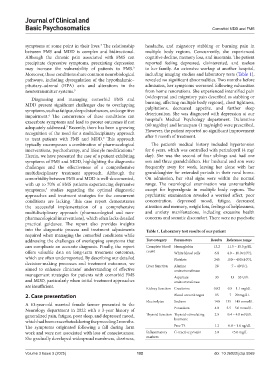
            Moreover, these conditions share common neurobiological   including imaging studies and laboratory tests (Table 1),
            pathways, including dysregulation of the hypothalamic–  revealed no significant abnormalities. Two months before
            pituitary–adrenal (HPA) axis and alterations in the   admission, her symptoms worsened following exhaustion
            neurotransmitter systems. 5                        from home renovations. She experienced intensified pain

              Diagnosing and managing comorbid FMS and         (widespread and migratory pain described as stabbing or
            MDD present significant challenges due to overlapping   burning, affecting multiple body regions), chest tightness,
            symptoms, such as fatigue, sleep disturbances, and cognitive   palpitations, decreased appetite, and further sleep
            impairment.  The concurrence of these conditions can   deterioration. She was diagnosed with depression at our
                      6
            exacerbate symptoms and lead to poorer outcomes if not   hospital’s Medical Psychology department. Duloxetine
            adequately addressed.  Recently, there has been a growing   (60 mg/day) and lorazepam (1 mg/night) were prescribed.
                             7
            recognition of the need for a multidisciplinary approach   However, the patient reported no significant improvement
                                             8
            to  treat  patients  with  FMS and  MDD.  This  approach   after 1 month of treatment.
            typically encompasses a combination of pharmacological   The patient’s medical history included hypertension
                                                          6
            interventions, psychotherapy, and lifestyle modifications.    for 6 years, which was controlled with perindopril (4 mg/
            Herein, we have presented the case of a patient exhibiting   day). She was the second of four siblings and had one
            symptoms of FMS and MDD, highlighting the diagnostic   son and three grandchildren. Her husband and son were
            challenges and the effectiveness of a comprehensive   frequently away for work, leaving her alone with her
            multidisciplinary treatment approach. Although the   granddaughter for extended periods in their rural home.
            comorbidity between FMS and MDD is well-documented,   On admission, her vital signs were within the normal
            with up to 70% of FMS patients experiencing depressive   range. The neurological examination was unremarkable
            symptoms,  studies regarding the optimal diagnostic   except for hyperalgesia in multiple body regions. The
                    4
            approaches and treatment strategies for the concurrent   psychiatric examination revealed a worried affect, poor
            conditions  are lacking.  This case  report  demonstrates   concentration, depressed mood, fatigue, decreased
            the successful implementation of a comprehensive   attention and memory, weight loss, feelings of helplessness,
            multidisciplinary approach (pharmacological and non-  and anxiety manifestations, including excessive health
            pharmacological interventions), which often lacks detailed   concerns and somatic discomfort. There were no psychotic
            practical guidance. The report also provides insights
            into the diagnostic process and treatment adjustments   Table 1. Laboratory test results of our patient
            required when managing the comorbid conditions while
            addressing the challenges of overlapping symptoms that   Test category  Parameters  Results  Reference range
            can complicate an accurate diagnosis. Finally, the report   Complete blood  Hemoglobin  13.2  11.5 – 15.5 g/dL
            offers valuable data on long-term treatment outcomes,   count  White blood cells  6.8  4.0 – 10.0×10 /L
                                                                                                          9
            which are often underreported. By describing our detailed      Platelets        245   150 – 450×10 /L
                                                                                                          9
            decision-making processes and treatment outcomes, we   Liver function  Alanine   28    7 – 40 U/L
            aimed to enhance clinicians’ understanding of effective        aminotransferase
            management strategies for patients with comorbid FMS           Aspartate         33    13 – 35 U/L
            and MDD, particularly when initial treatment approaches        aminotransferase
            are insufficient.
                                                               Kidney function Creatinine   0.82  0.5 – 1.1 mg/dL
            2. Case presentation                                           Blood urea nitrogen  15  7 – 20 mg/dL
                                                               Electrolytes  Sodium         140  135 – 145 mmol/L
            A 63-year-old married female farmer presented to the
            Neurology department in 2022 with a 3-year history of          Potassium        4.0  3.5 – 5.0 mmol/L
            generalized pain, fatigue, poor sleep, and depressed mood,   Thyroid function Thyroid-stimulating   2.5  0.4 – 4.0 mIU/L
            which had been exacerbated during the preceding 2 months.      hormone
            The symptoms originated following a fall during farm           Free T4          1.2   0.8 – 1.8 ng/dL
            work and were not associated with loss of consciousness.   Inflammatory   C-reactive protein  3.0  <5.0 mg/L
            She gradually developed widespread numbness, dizziness,   markers


            Volume 3 Issue 3 (2025)                        102                              doi: 10.36922/jcbp.5069

