


Page 109 - JCBP-3-3
P. 109
Journal of Clinical and
            Basic Psychosomatics                                                           Comorbid MDD and FMS


            symptoms. Laboratory tests and imaging studies, including   The final diagnosis was recurrent severe MDD and
            electrocardiogram, spot electroencephalogram, cardiac and   FMS. Thus, she was administered pregabalin (75 mg twice
            abdominal ultrasound, and chest computed tomography,   daily),  venlafaxine extended-release (225 mg once daily),
                                                                    10
            revealed no significant abnormalities. Brain magnetic   and lorazepam (0.5 mg at bedtime). By day 12, the patient
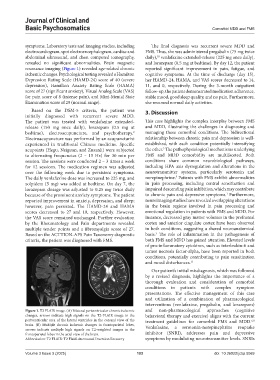
            resonance imaging (Figure 1) revealed age-related chronic   reported significant improvement in pain, fatigue, and
            ischemic changes. Psychological testing revealed a Hamilton   cognitive symptoms. At the time of discharge (day 15),
            Depression Rating Scale (HAMD-24) score of 40 (severe   her HAMD-24, HAMA, and VAS scores decreased to 14,
            depression), Hamilton Anxiety Rating Scale (HAMA)   11, and 0, respectively. During the 3-month outpatient
            score of 27 (significant anxiety), Visual Analog Scale (VAS)   follow-up, the patient demonstrated medication adherence,
            for pain score of 8 (intense pain), and Mini-Mental State   stable mood, good sleep quality, and no pain. Furthermore,
            Examination score of 29 (normal range).            she resumed normal daily activities.
              Based on the DSM-5 criteria, the patient was     3. Discussion
            initially  diagnosed  with  recurrent  severe  MDD.
            The patient was treated with venlafaxine extended-  This case highlights the complex interplay between FMS
            release (150  mg  once  daily),  lorazepam  (0.5  mg  at   and MDD, illustrating the challenges in diagnosing and
            bedtime),  electroacupuncture,  and  psychotherapy.    managing these comorbid conditions. The bidirectional
                                                          9
            Electroacupuncture was performed by an acupuncturist   relationship between chronic pain and depression is well-
            experienced in traditional Chinese medicine. Specific   established,  with  each  condition  potentially  intensifying
                                                                      3
            acupoints (Hegu, Neiguan, and Zusanli) were subjected   the other.  The pathophysiological mechanisms underlying
            to alternating frequencies (2 – 15  Hz) for 30  min per   FMS and MDD comorbidity are multifaceted. Both
            session. The sessions were conducted 2 – 3 times a week   conditions share common neurobiological pathways,
            for 12 sessions. The medication regimen was adjusted   including HPA axis dysregulation and alterations in the
            over the following week due to persistent symptoms.   neurotransmitter systems, particularly serotonin and
            The daily venlafaxine dose was increased to 225 mg, and   norepinephrine.  Patients with FMS exhibit abnormalities
                                                                            5
            zolpidem (5 mg) was added at bedtime. On day 7, the   in pain processing, including central sensitization and
            lorazepam dosage was adjusted to 0.25  mg twice daily   impaired descending pain inhibition, which may contribute
            because of the prominent anxiety symptoms. The patient   to chronic pain and depressive symptoms.  Furthermore,
                                                                                                 1
            reported improvement in anxiety, depression, and sleep;   neuroimaging studies have revealed overlapping alterations
            however, pain persisted. The HAMD-24 and HAMA      in the brain regions involved in pain processing and
            scores decreased to 27 and 10, respectively. However,   emotional regulation in patients with FMS and MDD. For
            the VAS score remained unchanged. Further evaluation   instance, decreased gray matter volumes in the prefrontal
            by the Rheumatology and Pain departments revealed   cortex and anterior cingulate cortex have been observed
            multiple tender points and a fibromyalgia score of 27.   in both conditions, suggesting a shared neuroanatomical
                                                                   3
            Based on the ACTTION-APS Pain Taxonomy diagnostic   basis.  The role of inflammation in the pathogenesis of
            criteria, the patient was diagnosed with FMS.      both FMS and MDD has gained attention. Elevated levels
                                                               of pro-inflammatory cytokines, such as interleukin-6 and
                                                               tumor necrosis factor-alpha, have been reported in both
                                                               conditions, potentially contributing to pain sensitization
                                                               and mood disturbances. 11
                                                                 Our patient’s initial misdiagnosis, which was followed
                                                               by a revised diagnosis, highlights the importance of a
                                                               thorough  evaluation  and  consideration  of  comorbid
                                                               conditions in patients with complex symptom
                                                               presentations. The effective management of this case
                                                               and utilization of a combination of pharmacological
                                                               interventions (venlafaxine, pregabalin, and lorazepam)
            Figure 1. T2 FLAIR image. (A) Bilateral periventricular chronic ischemic   and  non-pharmacological  approaches  (cognitive
            changes, arrows indicate high signals on the T2-FLAIR image in the   behavioral therapy and exercise) aligns with the current
            periventricular area of the lateral ventricles in the coronal view of the   treatment guidelines for comorbid FMS and MDD.
                                                                                                            6,8
            brain. (B) Multiple chronic ischemic changes in frontoparietal lobes,   Venlafaxine, a serotonin-norepinephrine reuptake
            arrows indicate multiple high signals on T2-weighted images in the
            frontoparietal lobes in the axial view of the brain.  inhibitor (SNRI), addresses pain and depressive
            Abbreviation: T2 FLAIR: T2 Fluid-Attenuated Inversion Recovery  symptoms by modulating neurotransmitter levels. SNRIs


            Volume 3 Issue 3 (2025)                        103                              doi: 10.36922/jcbp.5069

