


Page 92 - JCTR-10-1
P. 92
88                        Tsunou et al. | Journal of Clinical and Translational Research 2024; 10(1): 85-92
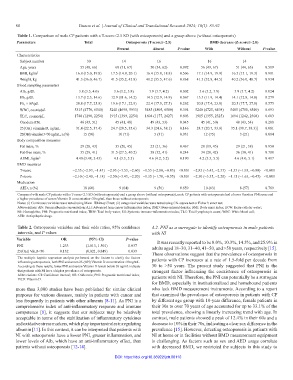
        Table 1. Comparison of male CP patients with a T-score<2.5 SD (with osteoporosis) and a group above (without osteoporosis)
        Parameters                  Total             Osteoporosis (T‑score≤−2.5)        BMD decrease (Z‑score≤−2.0)
                                                  Present        Absent    P‑value     With         Without    P‑value
        Characteristics
         Subject number              30             14             16                   16            14
         Age, years                55 (48, 66)   60 (51, 67)    50 (34, 62)  0.092   56 (49, 67)    51 (44, 63)  0.519
         BMI, kg/m 2             16.8 (15.0, 19.8)  17.5 (14.9, 20.1)  16.4 (15.0, 18.8)  0.506  17.1 (14.9, 19.9)  16.5 (15.1, 19.3)  0.901
         Weight, kg              41.3 (36.0, 46.7)  41.5 (35.2, 45.8)  40.2 (35.5, 47.6)  0.868  41.5 (32.8, 44.5)  40.2 (36.0, 48.7)  0.934
        Blood sampling parameters
         Alb, g/dL                3.8 (3.5, 4.0)  3.6 (3.2, 3.8)  3.9 (3.7, 4.2)  0.002  3.6 (3.2, 3.9)  3.9 (3.7, 4.2)  0.024
         Hb, g/dL                13.7 (12.5, 14.6)  12.9 (11.6, 14.2)  14.5 (12.9, 14.9)  0.067  13.3 (11.9, 14.4)  14.1 (12.8, 14.8)  0.279
         Plt, ×10 /μL            20.8 (17.7, 25.8)  19.6 (17.1, 22.9)  22.4 (17.9, 27.5)  0.262  20.8 (17.4, 23.8)  20.5 (17.7, 27.8)  0.575
              4
         WBC, counts/μL         5315 (4770, 6540)  5240 (4698, 5933)  5485 (4805, 6580)  0.394  5240 (4725, 6498)  5485 (4780, 6540)  0.693
         TLC, counts/μL         1748 (1290, 2254)  1915 (1399, 2254)  1694 (1177, 2427)  0.603  1915 (1355, 2325)  1694 (1242, 2308)  0.603
         Onodera-PNI               46 (43, 51)   45 (41, 48)    49 (43, 53)  0.045   45 (41, 50)    48 (43, 54)  0.208
         25(OH) vitamin D, ng/mL  31.4 (22.5, 37.4)  24.7 (20.5, 35.6)  34.3 (24.6, 38.1)  0.146  24.7 (20.7, 33.9)  35.1 (30.7, 38.3)]  0.081
         25(OH) vitamin D<30 ng/mL, n (%)  15 (50)  10 (71)      5 (31)     0.031     12 (75)        3 (21)     0.004
        Body composition measures
         Fat mass, %               29 (20, 43)   35 (20, 45)    25 (21, 36)  0.467   28 (19, 45)    29 (21, 38)  0.950
         Fat-free mass, %          35 (29, 41)  31.5 (27.5, 40.2)  38 (32, 41)  0.244  34 (28, 42)  36 (30, 41)  0.708
         ASMI, kg/m 2            4.40 (3.48, 5.43)  4.1 (3.3, 5.5)  4.6 (4.2, 5.2)  0.190  4.2 (3.3, 5.5)  4.6 (4.0, 5.1)  0.417
        BMD measures
         T-score               −2.35 (−2.93, −1.43) −2.95 (−3.53, −2.60) −1.55 (−2.00, −0.83)  <0.001 −2.85 (−3.45, −2.53) −1.35 (−1.93, −0.80) <0.001
         Z-score               −2.10 (−2.40, −1.18) −2.50 (−3.43, −2.20) −1.35 (−1.78, −0.55)  <0.001 −2.30 (−3.35, −2.20) −1.15 (−1.63, −0.45) <0.001
        Medication
         AED, n (%)                 18 (60)        9 (64)        9 (56)     0.659     10 (63)        8 (57)     0.769
        Compared with male CP patients with a T-score<2.5 SD (with osteoporosis) and a group above (without osteoporosis), male CP patients with osteoporosis had a lower Onodera PNI score and
        a higher prevalence of serum Vitamin D concentration<30 ng/mL than those without osteoporosis.
        Notes: (i) Continuous variables were tested using Mann–Whitney U test; (ii) categorical variables were tested using Chi-square test or Fisher’s exact test.
        Abbreviations: Alb: Serum albumin concentration; ALI: Advanced lung cancer inflammation index; BMD: Bone mineral density; BMI: Body mass index; ECW: Extra-cellular water;
        Hb: Hemoglobin; PNI: Prognostic nutritional index; TBW: Total body water; SII: Systemic immune-inflammation index; TLC: Total lymphocyte count; WBC: White blood cell;
        AED: Antiepileptic drugs.
        Table 2. Osteoporosis variables and their odds ratios, 95% confidence   4.2. PNI as a surrogate to identify osteoporosis in male patients
        intervals, and P values                                 with NI
        Variable          OR          (95% Cl)        P‑value      It was recently reported to be 8.0%, 10.3%, 14.5%, and 25.9% in
        PNI               1.233      (1.013, 1.501)    0.037    adults aged 18–30, 31–40, 41–50, and >50 years, respectively [15].
        25(OH) Vit.D<30   0.132      (0.021, 0.849)    0.033    These observations suggest that the prevalence of osteoporosis in
        The multiple logistic regression analysis performed on the factors to clarify the factors   patients with CP increases at a rate of 1.5-fold per decade from
        influencing osteoporosis, both PNI and serum 25-(OH) Vitamin D concentration<30 ng/mL.
        According to these results, lower PNI and serum Vitamin D levels below 30 ng/mL indicate   30  to  >50  years.  The  present  study  suggested  that  PNI  is  the
        that patients with NI have a higher prevalence of osteoporosis.  strongest  factor  influencing  the  coexistence  of  osteoporosis  in
        Abbreviations: CI: Confidence interval; OR: Odds ratio; PNI: Prognostic nutritional index;   patients with NI. Therefore, the PNI can potentially be a surrogate
        Vit.D: Vitamin D.
                                                                for BMD, especially in institutionalized and homebound patients
        more than 3,000 studies have been published for similar clinical   who lack BMD measurement instruments. According to a report
        purposes for various diseases, mainly in patients with cancer and   that examined the prevalence of osteoporosis in patients with CP
        less frequently in patients with other ailments [8-11]. As PNI is a   by different age group with 10-year difference, female patients in
        comprehensive index of anti-inflammatory response and immune   their 30s to over 70 years of age accounted for up to 33.1% of the
        competence  [8], it suggests that our subjects may be relatively   total prevalence, showing a linearly increasing trend with age. In
        acceptable in terms of the stabilization of inflammatory cytokines   contrast, male patients showed a peak of 12.4% in their 60s and a
        and oxidative stress markers, which play important roles in regulating   decrease to 10% in their 70s, indicating a clear sex difference in the
        albumin [11]. In this context, it can be interpreted that patients with   prevalence [15]. However, detecting osteoporosis in patients with
        NI with osteoporosis have a lower PNI, greater inflammation, and   NI at home or in facilities without BMD measurement equipment
        lower levels of Alb, which have an anti-inflammatory effect, than   is challenging. As factors such as sex and AED usage correlate
        patients without osteoporosis [12-14].                  with decreased BMD, we restricted the subjects in this study to
                                                   DOI: https://doi.org/10.36922/jctr.00110

