


Page 91 - JCTR-10-1
P. 91
Tsunou et al. | Journal of Clinical and Translational Research 2024; 10(1): 85-92   87
        were evaluated using the Mann–Whitney U-test for continuous   the osteoporosis group (3.6 g/dL vs. 3.9 g/dL, P = 0.002; 45 vs. 49,
        variables  and the  χ² test or Fisher’s exact  test for categorical   P = 0.045). Furthermore, the number of patients with 25-OH VD
        variables. In method 2, multiple logistic regression analysis was   levels of <30 ng/mL was significantly higher in the osteoporosis
        performed, and in method 3, the area under the curve (AUC) and   group  (71%  vs.  31%,  P = 0.031).  These  results  indicate  that,
        95% confidence interval (CI) were determined using ROC curve   compared with patients without osteoporosis, patients diagnosed
        analysis. The AUC with 95% CI was considered significant when   with osteoporosis by their T-score had (1) significantly lower Alb
        the AUC was 1.0 but not when the AUC was 0.5. The point with   and PNI and (2) serum 25-OH VD <30 ng/mL and the number of
        the highest sensitivity of (1 - specificity) was defined as the more   patients with Vitamin D insufficiency was significantly higher in
        effective  cutoff  value.  Statistical  significance  was  defined  as   the osteoporosis group.
        P < 0.05. SPSS version 29 (IBM, Armonk, NY, USA) was used
        for all the statistical analyses.                       3.2. Lower PNI and Vitamin D insufficiency influence
                                                                osteoporosis in patients with NI
        3. Results
                                                                   Multiple logistic regression analysis revealed that PNI  and
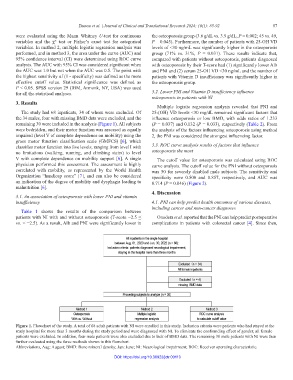
          The study had 68 inpatients, 34 of whom were excluded. Of   25-(OH) VD levels <30 mg/dL remained significant factors that
        the 34 males, four with missing BMD data were excluded, and the   influence  osteoporosis  or  low  BMD,  with  odds  ratios  of  1.233
        remaining 30 were included in the analysis (Figure 1). All subjects   (P = 0.037) and 0.132 (P = 0.033), respectively (Table 2). From
        were bedridden, and their motor function was assessed as equally   the analysis of the factors influencing osteoporosis using method
        impaired (level V of complete dependence on mobility) using the   2, the PNI was considered the strongest influencing factor.
        gross  motor  function  classification  scale  (GMFCS)  [6], which
        classifies motor function into five levels, ranging from level I with   3.3. ROC curve analysis results of factors that influence
        no limitations  (walking, running, and climbing  stairs) to level   osteoporosis the most
        V with complete dependence on mobility support [6]. A single   The cutoff value for osteoporosis was calculated using ROC
        physician  performed  this assessment. The  assessment is highly   curve analysis. The cutoff value for the PNI without osteoporosis
        correlated  with mobility, as represented by the  World Health   was 50 for severely disabled male subjects. The sensitivity and
        Organization  “handicap  score”  [7], and can also be considered   specificity  were  0.500  and  0.857,  respectively,  and  AUC  was
        an indication of the degree of mobility and dysphagia leading to   0.714 (P = 0.046) (Figure 2).
        malnutrition [6].
                                                                4. Discussion
        3.1. An association of osteoporosis with lower PNI and vitamin
        insufficiency                                           4.1. PNI can help predict health outcomes of various diseases,
                                                                including cancer and non-cancer diagnoses
          Table  1  shows the results of the  comparison between
        patients with NI with and without osteoporosis (T-score −2.5 ≤   Onodera et al. reported that the PNI can help predict postoperative
        vs. < −2.5). As a result, Alb and PNI were significantly lower in   complications  in  patients  with  colorectal  cancer  [4]. Since then,


        Figure 1. Flowchart of the study. A total of 68 adult patients with NI were enrolled in this study. Inclusion criteria were patients who had stayed at the
        study hospital for more than 3 months during the study period and were diagnosed with NI. To eliminate the confounding effect of gender, all female
        patients were excluded. In addition, four male patients were also excluded due to lack of BMD data. The remaining 30 male patients with NI were then
        further evaluated using the three methods shown in this flowchart.
        Abbreviations, Aug: August; BMD: Bone mineral density; Jun: June; NI: Neurological impairment; ROC: Receiver operating characteristic.
                                                  DOI: https://doi.org/10.36922/jctr.00110

