


Page 20 - JCTR-10-2
P. 20
114                       Jangid et al. | Journal of Clinical and Translational Research 2024; 10(2): 112-118
        3. Results                                               Table 1. Comparison of the mean OHL-AQ, HeLD, and REALMD-20
                                                                 scores based on gender
          In this study, there  were a total  of 180 participants,  with   Scales  N  Mean  SD   SEM   t‑value  P‑value
        112  (62.22%) being  male  and 68  (37.78%) being  female.   OHL-AQ
        The  mean  scores  for  HeLD  in  different  domains,  including   Male  112  6.2  3.626  0.343  −3.548  0
        receptivity, understanding,  support, economic  barriers,  access,
        communication,  and utilization  [3], were 17.75, 10.55, 10.572,   Female  68  8.19  3.707  0.449
        10.439, 13.961, 24.89, and 14.27, respectively.          HeLD
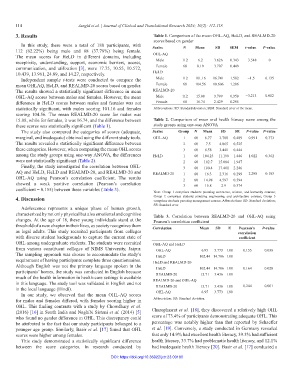
          Independent  sample  t-tests were conducted  to compare the   Male   112  101.16  16.741  1.582  −1.5  0.135
        mean OHLAQ, HeLD, and REALMD-20 scores based on gender.   Female     68    104.56  10.606  1.286
        The results showed a statistically significant difference in mean   REALMD-20
        OHL-AQ scores between males and females. However, the mean   Male    112   15.08  3.799  0.359  −3.213  0.002
        difference in HeLD scores between males and females was not   Female   68  16.74  2.429  0.295
        statistically  significant,  with  males  scoring  101.16  and  females   Abbreviations: SD: Standard deviation; SEM: Standard error of the mean.
        scoring 104.56.  The mean REALMD-20  score for males was
        15.08, while for females, it was 16.74, and the difference between   Table  2. Comparison of mean  oral health  literacy  score among the
        these scores was statistically significant (Table 1).    study groups using one-way ANOVA
          The study also compared the categories of scores (adequate,   Scales  Group  N  Mean  SD  SE  F‑value  P‑value
        marginal, and inadequate) obtained using the different study tools.   OHL-AQ  1  60  6.77  3.788  0.489  0.991  0.373
        The results revealed a statistically significant difference between   2   60   7.5   4.065  0.525
        these categories. However, when comparing the mean OHL scores         3   60   6.58  3.441  0.444
        among the study groups using one-way ANOVA, the differences   HeLD    1   60  104.23  11.198  1.446  1.022  0.362
        were not statistically significant (Table 2).                         2   60  102.7  15.084  1.947
          Finally, the study investigated the correlation between OHL-        3   60  100.4  17.401  2.246
        AQ and HeLD, HeLD and REALMD-20, and REALMD-20 and       REALMD-20    1   60   16.3  2.316  0.299  2.298  0.103
        OHL-AQ  using  Pearson’s  correlation  coefficient.  The  results     2   60  14.98  4.597  0.594
        showed a weak positive correlation  (Pearson’s correlation            3   60   15.8  2.9   0.374
        coefficient = 0.155) between these variables (Table 3).
                                                                 Note: Group 1 comprises students pursuing commerce,  science, and humanity courses;
        4. Discussion                                            Group  2 comprises students pursuing engineering and architecture  courses; Group  3
                                                                 comprises students pursuing management courses. Abbreviations: SD: Standard deviation;
                                                                 SE: Standard error.
          Adolescence represents a unique phase of human growth,
        characterized by not only physical but also emotional and cognitive   Table  3. Correlation  between  REALMD-20 and  OHL-AQ using
        changes. At the age of 18, these young individuals stand at the   Pearson’s correlation coefficient
        threshold of a new chapter in their lives, as society recognizes them   Correlation  Mean  SD  N  Pearson’s   P‑value
        as  legal  adults.  This  study  recruited  participants  from  colleges                    correlation
        with diverse student backgrounds to capture the current state of                             coefficient
        OHL among undergraduate students. The students were recruited   OHL-AQ and HeLD
        from various constituent  colleges of NIMS University, Jaipur.   OHL-AQ      6.95  3.773  180  0.155   0.038
        The sampling approach was chosen to accommodate the study’s   HeLD          102.44 14.786 180
        requirement of having participants complete three questionnaires.   HeLD and REALMD-20
        Although  English was not  the  primary  language  spoken in  the   HeLD    102.44 14.786 180  0.164   0.028
        participants’ homes, the study was conducted in English because   REALMD-20  15.71  3.436  180
        much of the health information in health-care settings is available   REALMD-20 and OHL-AQ
        in this language. The study tool was validated in English and not   REALMD-20  15.71  3.436  180  0.244  0.001
        in the local language (Hindi).                            OHL-AQ             6.95  3.773  180
          In our study, we observed that  the mean  OHL-AQ  scores
        for  males  and  females  differed,  with  females  scoring  higher  in   Abbreviation: SD: Standard deviation.
        OHL. This finding contrasts with a study by Chowdhary et al.
        (2016) [16] in South India and Naghibi Sistani et al. (2014) [5]   Charophasrat et al. [18], they discovered a relatively high OHL
        who found no gender difference in OHL. This discrepancy could   score of 73.4% of participants demonstrating adequate OHL. This
        be attributed to the fact that our study participants belonged to a   percentage  was  notably  higher  than  that  reported  by  Schaeffer
        younger age group. Similarly, Basir et al. [17] found that OHL   et al. [19]. Conversely, a study conducted in Germany revealed
        scores were higher among females.                       that only 14.9% had excellent health literacy, 39.3% had sufficient
          This  study  demonstrated  a  statistically  significant  difference   health literacy, 33.7% had problematic health literacy, and 12.1%
        between  the  score  categories.  In research  conducted  by   had inadequate health literacy [20]. Basir et al. [17] conducted a
                                                DOI: https://doi.org/10.36922/jctr.23.00100

