


Page 9 - JCTR-10-6
P. 9
Hanno et al.ǀ Journal of Clinical and Translational Research 2024; 10(6): 317-324   319
        2. Methods                                             two patients from the vonoprazan group did not complete the
                                                               study, and 14 patients from the PPI group voluntarily stopped
        2.1. Study design                                      the drug regimen and did not complete the study.
          This  was  a  prospective,  controlled,  multicenter,  parallel-  The  final  sample  size  was  1184  patients,  and  they  were
        assignment,  and  open-label  study  involving  patients  selected   divided accordingly in the study: 701 naïve patients received
        from the gastroenterology and/or tropical medicine departments,   first-line  therapy  (355  patients  received  a  triple  vonoprazan-
        as well as inpatient and outpatient clinics, from 12 university   based  regimen,  and  346  patients  received  a  triple  PPI-based
        centers across Egypt (i.e., Faculty of Medicine of Alexandria   regimen),  and  483  experienced  patients  received  the  second-
        University, Al-Azhar University, Ain Shams University, Cairo   line  therapy  (243  patients  received  quadrable  vonoprazan-
        University,   Assiut   University,   Mansoura   University,   based regimen, and 240 patients received quadrable PPI-based
        Tanta  University,  Minia  University,  South  Valley  University,   regimen). After  recruitment  and  allocation,  all  patients  were
        Zagazig University, Benha University; Faculty of Medicine and   subjected to the following:
        National Liver Institute of Menoufia University). The study was   (i)  Full  history  and  complete  clinical  examination:  stool
        conducted from January 1, 2022, to June 30, 2022.         analysis,  urine,  complete  blood count,  H. pylori  antigen
          The  inclusion  criteria  were  patients  (i)  above  18  years   (Ag) in stool (quantitative assay), and serum creatinine.
        of  matched  age  and  sex,  and  (ii)  provided  written  informed   (ii)  The presence of H. pylori was confirmed by the H. pylori
        consent before study participation. The exclusion criteria were   SAT before study treatment administration and 4 weeks after
        patients (i) with known allergy to any of the treatment drugs;   the  treatment  regimen;  antibiotics  and  acid-suppressive
        (ii)  refused  to  sign  an  informed  consent;  (iii)  had  surgery   therapies were discontinued 2 weeks before doing the test.
        that  might  affect  gastric  acid  secretion  (upper  GI  resection   During follow-ups, the patients were contacted by telephone
        or  vagotomy),  Zollinger–Ellison  syndrome,  or  other  gastric   after 1 week of starting the regimen to check compliance. The
        acid  hypersecretion  disorders;  (iv)  had  serious  neurological,   first follow-up visit was after completing 2 weeks of treatment
        cardiovascular,  pulmonary,  hepatic,  renal,  metabolic,  GI,   to register any adverse events. The second follow-up visit was
        urological,  endocrinological,  or  hematological  disorders;   after completing 4 weeks of the treatment regimen to register
        (v)  need  surgery,  history  of  drug  (including  alcohol)  abuse,   the eradication results.
        history of malignancy, and female subjects who are pregnant   The primary purpose of the trial was to increase the rate of first-
        or lactating; (vi) pregnancy or planning for pregnancy during   line H. pylori elimination. The second endpoint was the rate of H.
        the study period; and (vii) on PPIs, P-CABs, and/or antibiotics   pylori elimination in those who failed the first line of therapy.
        within 1 month before inclusion in the study.            The  incidence  of  treatment-emergent  adverse  events  was
          Patients  who  fulfilled  the  study  inclusion  criteria  were   recorded. The principal investigator supervised the assessment
        allocated to one group of study as follows:            of  the  safety  of  triple  and  quadrable  therapy  for  H. pylori
        (i)  Group-I: Naïve patients (patients who did not receive any   eradication in the local population.
           prior H. pylori eradication regimens)
           •   Arm  1:  Patients  received  vonoprazan  triple  therapy:   2.3. Statistical analysis
               CLA 500 mg twice daily (bis in die [BID]) + AMO 1 g   The sample size was calculated using Power Analysis and
               BID + vonoprazan 20 mg BID for 14 days          Sample  Size  software  (PASS  2020;  ncss.com/software/pass;
           •   Arm  2:  Patients  received  the  classic  triple  therapy:   NCSS,  LLC.,  USA). The  minimal  total  hypothesized  sample
               CLA 500 mg BID + AMO 1 g BID + PPI “omeprazole   size  of  800  eligible  patients  (400  per  group)  is  required  to
               40 mg” BID for 14 days                          compare the efficacy of vonoprazan and PPI in Egypt’s first- and
        (ii)  Group-II: Non-responders (patients who did not respond to   second-line  H. pylori  eradication  regimens.  This  calculation
           the previous first-line eradication regimen):       assumes a 25% effect size (i.e., a minimally clinically important
           •   Arm  1:  Patients  received  vonoprazan-based  non-  difference), a 95% confidence level, a 1:1 compliance ratio, and
               bismuth quadruple therapy: levofloxacin 500 mg once   80% power, using the Chi-square test [25,26]. The sample size
               daily (OD) + vonoprazan 20 mg BID + nitazoxanide   was estimated based on the formula:
               500 mg BID + doxycycline 100 mg OD for 14 days
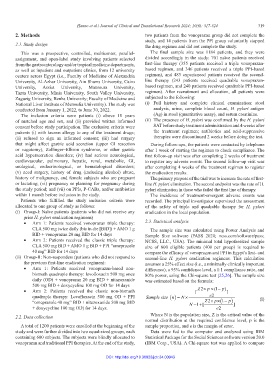
                                                                                           × − p)
           •   Arm  2:  Patients  received  the  classic  non-bismuth               [ Z2 × p (1  ]
               quadruple  therapy:  Levofloxacin  500  mg  OD  +  PPI   Sample size n () = N ×  e2             (I)
                                                                                            p
               “omeprazole 40 mg” BID + nitazoxanide 500 mg BID                   N 1   Z2 ××(1  − ) p  ]
                                                                                   −+[
               + doxycycline 100 mg OD) for 14 days.                                         e2
        2.2. Data collection                                     Where N is the population size, Z is the critical value of the
                                                               normal  distribution  at  the  required  confidence  level,  p  is  the
          A total of 1200 patients were enrolled at the beginning of the   sample proportion, and e is the margin of error.
        study and were further divided into two equal-sized groups, each   Data  were  fed  to  the  computer  and  analyzed  using  IBM
        containing 600 subjects. The subjects were blindly allocated to   Statistical Package for the Social Sciences software version 20.0
        vonoprazan and traditional PPI therapies. At the end of the study,   (IBM Corp., USA). A Chi-square test was applied to compare


                                               DOI: http://doi.org/10.36922/jctr.24.00043

