


Page 10 - JCTR-10-6
P. 10
320                       Hanno et al.ǀ Journal of Clinical and Translational Research 2024; 10(6): 317-324
        different categories. The significance of the obtained results was   Table 4 shows different regimens for previous Helicobacter
        judged at the 5% level.                                pylori  treatment.  Among  the  483  experienced  patients,  119
                                                               (24.64%) of them received PPI, amoxicillin and clarithromycin,
        3. Results                                             and  154  (31.88%)  patients  received  PPI,  amoxicillin  and
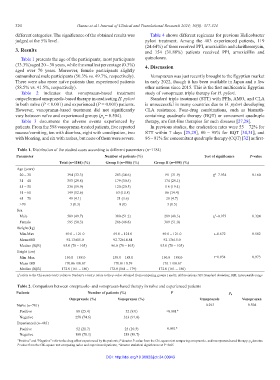
          Table 1 presents the age of the participants; most participants   quinolones.
        (33.3%) aged 20 – 30 years, while the smallest percentage (0.3%)   4. Discussion
        aged  over  70  years.  Moreover,  female  participants  slightly
        outnumbered male participants (50.3% vs. 49.7%, respectively).   Vonoprazan was just recently brought to the Egyptian market
        There were also more naïve patients than experienced patients   in early 2022, though it has been available in Japan and a few
        (58.5% vs. 41.5%, respectively).                       other nations since 2015. This is the first multicentric Egyptian
          Table  2  indicates  that  vonoprazan-based  treatment   study of vonoprazan triple therapy for H. pylori.
        outperformed omeprazole-based therapy in eradicating H. pylori   Standard triple treatment (STT) with PPIs, AMO, and CLA
        in both naïve (P < 0.001) and experienced (P = 0.001) patients.   is unsuccessful in many countries due to H. pylori developing
        However,  vonoprazan-based  treatment  did  not  significantly   CLA  resistance.  Four-drug  combinations,  such  as  bismuth-
        vary between naïve and experienced groups (p = 0.504).  containing quadruple therapy (BQT) or concurrent quadruple
                                             0
          Table  3  documents  the  adverse  events  experienced  by   therapy, are first-line therapies for such diseases [27,28].
        patients. From the 598 vonoprazan-treated patients, five reported   In previous studies, the eradication rates were 55 – 72% for
        nausea/vomiting, ten with diarrhea, eight with constipation, two   STT  within  7  days  [25,29],  80  –  95%  for  BQT  [30,31], and
        with bloating, and six with rashes, but none of them were severe.  86 – 91% for concomitant quadruple therapy (CQT) [32] as first-

        Table 1. Distribution of the studied cases according to different parameters (n=1184)
        Parameter                             Number of patients (%)                    Test of significance  P‑value
                          Total (n=1184) (%)  Group I (n=586) (%)  Group II (n=598) (%)
        Age (years)
         20 – 30              394 (33.3)          203 (34.6)           191 (31.9)           χ =7.934        0.160
                                                                                            2
         31 – 40              353 (29.8)          179 (30.5)           174 (29.1)
         41 – 50              236 (19.9)          120 (20.5)           116 (19.4)
         51 – 60              149 (12.6)          63 (10.8)            86 (14.4)
         61 – 70              49 (4.1)             21 (3.6)             28 (4.7)
         >70                   3 (0.3)              0 (0)               3 (0.5)
        Sex
                                                                                            2
         Male                 589 (49.7)          300 (51.2)           289 (48.3)           χ =0.973        0.324
         Female               595 (50.3)          286 (48.8)           309 (51.0)
        Weight (kg)
         Min-Max             69.0 – 121.0        69.0 – 121.0         69.0 – 121.0          t=0.672         0.502
         Mean±SD             92.13±15.0          92.72±14.84           92.13±15.0
         Median (IQR)       95.0 (78 – 105)     96.0 (78 – 105)      95.0 (78 – 105)
        Height (cm)
         Min–Max             150.0 – 188.0       150.0 – 188.0        150.0 – 188.0         t=0.034         0.973
         Mean±SD             170.06±10.67        170.0±10.59          170.1±10.67
         Median (IQR)      172.0 (161 – 180)    172.0 (161 – 179)   172.0 (161 – 180)
         2
        χ  refers to the Chi-square test; t refers to Student’s t-test; p refers to the p-value obtained from comparing groups I and II. Abbreviations: SD: Standard deviation; IQR: Interquartile range
        Table 2. Comparison between omeprazole- and vonoprazan-based therapy in naïve and experienced patients
        Patients                      Number of patients (%)              P                       p 0
                              Omeprazole (%)       Vonoprazan (%)                     Omeprazole        Vonoprazan
        Naïve (n=701)                                                                    0.293            0.504
         Positive                88 (25.4)            32 (9.0)          <0.001*
         Negative                258 (74.6)           323 (91.0)
        Experienced (n=483)
         Positive                52 (21.7)            25 (10.3)         0.001*
         Negative                188 (78.3)           218 (89.7)
        “Positive” and “Negative” refer to the drug effect experienced by the patients; P denotes P-value from the Chi-square test comparing omeprazole- and vonoprazan-based therapy; p  denotes
                                                                                                            0
        P-value from the Chi-square test comparing naïve and experienced patients; *denotes statistical significance at P<0.05
                                               DOI: http://doi.org/10.36922/jctr.24.00043

