


Page 39 - JCTR-11-3
P. 39
Journal of Clinical and
            Translational Research                                              Immunogenicity and safety of flu vaccines


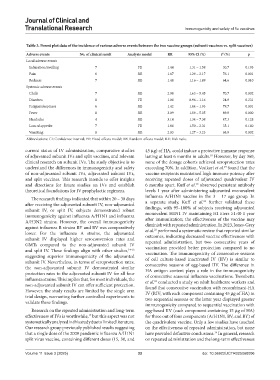
            Table 3. Forest plot data of the incidence of various adverse events between the two vaccine groups (subunit vaccines vs. split vaccines)

            Adverse events         No. of clinical result  Analysis model  RR    95% Cl (%)    I  (%)      p
                                                                                                2
            Local adverse events
             Induration/swelling          7                 FE          1.44      1.31 – 1.58   30.7     0.193
             Pain                         6                 RE          1.67      1.29 – 2.17   76.1     0.001
             Redness                      7                 RE          1.48      1.16 – 1.89   64.6     0.010
            Systemic adverse events
             Chills                       7                 RE          2.98      1.63 – 5.45   70.7     0.002
             Diarrhea                     8                 FE          1.06      0.96 – 1.16   24.8     0.231
             Fatigue/sleepiness           6                 RE          1.42      1.04 – 1.93   79.7     0.001
             Fever                        8                 RE          3.09      1.89 – 5.05   89.8     0.000
             Headache                     4                 RE          3.14      1.34 – 7.38   47.3     0.128
             Loss of appetite             7                 FE          1.86      1.50 – 2.31   35.1     0.160
             Vomiting                     8                 RE          2.03      1.27 – 3.23   68.8     0.002
            Abbreviations: CI: Confidence interval; FE: Fixed-effects model; RE: Random-effects model; RR: Risk ratio.

            current status of IV administration, comparative studies   45 μg) of HA, could induce a protective immune response
            of adjuvanted subunit IVs and split vaccines, and relevant   lasting at least 6 months in adults.  However, by day 360,
                                                                                          18
            clinical research on subunit IVs. The study objective is to   none of the dosage cohorts achieved seroprotection rates
            understand the differences in immunogenicity and safety   exceeding 70%. In addition, Vesikari et al.  found that the
                                                                                                19
            of non-adjuvanted subunit  IVs, adjuvanted subunit  IVs,   vaccine recipients maintained high immune potency after
            and split vaccines. This research intends to offer insights   receiving repeated doses of adjuvanted quadrivalent IV
            and directions for future studies on IVs and establish   6 months apart. Kuff et al.  observed persistent antibody
                                                                                    20
            theoretical foundations for IV prophylactic regimens.  levels  1  year after  administering  adjuvanted monovalent
                                                               influenza A/H1N1 vaccine in the 3 – 17 age group. In
              The research findings indicated that within 20 – 30 days                  21
            after receiving the adjuvanted subunit IV, non-adjuvanted   a separate study, Kuff  et al.  further validated these
            subunit  IV, or split IV, subjects demonstrated robust   findings,  with  95–100%  of subjects  receiving  adjuvanted
            immunogenicity against influenza A/H1N1 and influenza   monovalent H1N1 IV maintaining HI titers ≥1:40 1 year
            A/H3N2 strains. However, the overall immunogenicity   after immunization; the effectiveness of the vaccine may
                                                               diminish with repeated administration. In 2023, Jones-Gray
            against influenza B strains BY and BV was comparatively   et al.  performed a systematic review that reported similar
                                                                   22
            lower. For the influenza A strains, the adjuvanted   outcomes, indicating decreased vaccine effectiveness with
            subunit  IV displayed higher seroconversion rates and
            GMTs compared to the non-adjuvanted subunit  IV    repeated administration,  but two  consecutive years  of
                                                               vaccination provided better protection compared to no
            and split IV. These findings align with other studies, 14-16    vaccination. The immunogenicity of consecutive seasons
            suggesting superior immunogenicity of the adjuvanted   of cell culture-based inactivated IV  (IIV)  is similar  to
            subunit IV. Nevertheless, in terms of seroprotection rates,   consecutive seasons of egg-based IIV. The difference in
            the non-adjuvanted subunit  IV demonstrated similar   HA antigen content plays a role in the immunogenicity
            protection rates to the adjuvanted subunit IV for all four   of consecutive seasonal influenza vaccinations. Trombetta
            influenza strains. This implies that, for most individuals, the   et al.  conducted a study on adult healthcare workers and
                                                                   23
            non-adjuvanted subunit IV can offer sufficient protection.   found that consecutive vaccination with recombinant-HA
            However, the study results are limited by the single arm   IV (RIV; with each component containing 45 μg of HA) in
            trial design, warranting further controlled experiments to   two sequential seasons or the latter year displayed greater
            validate these findings.                           immunogenicity compared to sequential vaccination with
              Research on the repeated administration and long-term   egg-based IIV (each component containing 15 μg of HA)
            effectiveness of IVs is worthwhile,  but this aspect was not   for three out of four components (A/H1N1, BV, and BY) of
                                       17
            systematically analyzed in this study due to limited literature.   the quadrivalent vaccine. Only a few studies have touched
            Our research group previously published results suggesting   on the effectiveness of repeated administration, but none
            that a single dose of the 2009 pandemic influenza A/H1N1   have provided definitive conclusions.  In general, research
                                                                                            24
            split virus vaccine, containing different doses (15, 30, and   on repeated administration and the long-term effectiveness

            Volume 11 Issue 3 (2025)                        33                         doi: 10.36922/JCTR025060006

