


Page 38 - JCTR-11-3
P. 38
Journal of Clinical and
            Translational Research                                              Immunogenicity and safety of flu vaccines


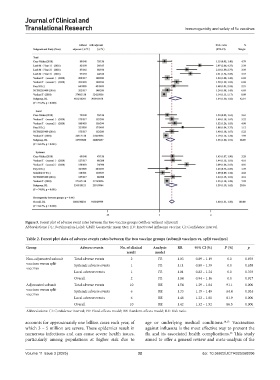
            Figure 5. Forest plot of adverse event rates between the two vaccine groups (with or without adjuvant)
            Abbreviations: DL: DerSimonian-Laird; GMT: Geometric mean titer; IIV: Inactivated influenza vaccine; CI: Confidence interval.

            Table 2. Forest plot data of adverse events rates between the two vaccine groups (subunit vaccines vs. split vaccines)
            Group                  Adverse events   No. of clinical   Analysis   RR  95% Cl (%)  I  (%)   p
                                                                                                 2
                                                       result      model
            Non-adjuvanted subunit   Total adverse events  2        FE      1.03    0.89 – 1.19   0.0    0.693
            vaccines versus split   Systemic adverse events  1      FE      1.11    0.88 – 1.39   0.0    0.658
            vaccines
                                 Local adverse events    1          FE      1.01    0.82 – 1.24   0.0    0.393
                                 Overall                 2          FE      1.04    0.94 – 1.16   0.0    0.917
            Adjuvanted subunit   Total adverse events   10          RE      1.54    1.29 – 1.84  91.1    0.000
            vaccines versus split   Systemic adverse events  6      RE      1.33    1.19 – 1.49  64.4    0.024
            vaccines
                                 Local adverse events    6          RE      1.48    1.22 – 1.80  81.9    0.000
                                 Overall                10          RE      1.42    1.32 – 1.52  86.5    0.000
            Abbreviations: CI: Confidence interval; FE: Fixed-effects model; RE: Random-effects model; RR: Risk ratio.

            accounts for approximately one billion cases each year, of   age or underlying medical conditions. 14,15  Vaccination
            which 3 – 5 million are severe. These epidemics result in   against influenza is the most effective way to prevent the
            numerous infections and can cause severe health issues,   flu and its associated health complications.  This study
                                                                                                   16
            particularly  among  populations  at  higher  risk  due  to   aimed to offer a general review and meta-analysis of the

            Volume 11 Issue 3 (2025)                        32                         doi: 10.36922/JCTR025060006

