


Page 58 - JCTR-11-3
P. 58
Journal of Clinical and
            Translational Research                                                       Telerehabilitation after stroke


            such as the small number of studies directly addressing the   Emmerson  et al.  conducted an RCT comparing
                                                                                10
            research question.                                 home exercise programs for post-stroke patients using
                                                               smart  technology  (videos  and  automated  reminders)
            3. Results                                         with traditional paper-based programs. Participants were

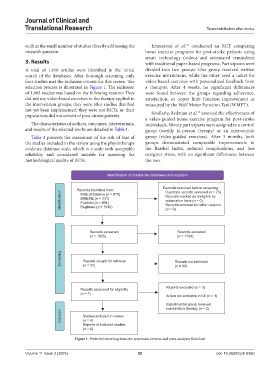
            A total of 1,910 articles were identified in the initial   divided into two groups: One group received written
            search of the databases. After thorough screening, only   exercise instructions, while the other used a tablet for
            four studies met the inclusion criteria for this review. The   video-based exercises with personalized feedback from
            selection process is illustrated in Figure 1. The exclusion   a  therapist.  After  4  weeks,  no  significant  differences
            of 1,903 studies was based on the following reasons: They   were found between the groups regarding adherence,
            did not use video-based exercises in the therapy applied to   satisfaction, or upper limb function improvement as
            the intervention groups; they were pilot studies that had   measured by the Wolf Motor Function Test (WMFT).
            not yet been implemented; they were not RCTs; or their                   13
            populations did not consist of post-stroke patients.  Similarly, Redzuan et al.  assessed the effectiveness of
                                                               a video-guided home exercise program for post-stroke
              The characteristics of authors, outcomes, interventions,   individuals. Ninety participants were assigned to a control
            and results of the selected works are detailed in Table 1.  group (weekly in-person therapy) or an intervention
              Table 2 presents the assessment of the risk of bias of   group (video-guided exercises). After 3  months, both
            the studies included in the review using the physiotherapy   groups demonstrated comparable improvements in
            evidence database scale, which is a scale with acceptable   the Barthel Index, reduced complications, and less
            reliability and considered suitable for assessing the   caregiver stress, with no significant differences between
            methodological quality of RCTs.                    the two.


                                               Identification of studies via databases and registers

                                                                      Records removed before screening:
                                  Records identified from:              Duplicate records removed (n = 75)
                           Identification    BIREME (n = 331)           Records marked as ineligible by
                                    Web of Science (n = 975)
                                                                        automation tools (n = 0)
                                    PubMed (n = 604)
                                                                        Records removed for other reasons
                                    Registers (n = 1910)
                                                                        (n = 0)


                                       Records screened                     Records excluded
                                       (n = 1835)                           (n = 1798)


                           Screening  Reports sought for retrieval         Reports not retrieved

                                    (n = 37)
                                                                           (n = 30)


                                                                        Reports excluded (n = 3)
                                   Reports assessed for eligibility
                                   (n = 7)                              Article not available in full (n = 1)
                                                                        Experimental group received
                                                                        combination therapy (n = 2)
                           Inclusion  Studies included in review
                                    (n = 4)
                                    Reports of included studies
                                    (n = 4)
                                 Figure 1. Preferred reporting items for systematic reviews and meta-analyses flowchart


            Volume 11 Issue 3 (2025)                        52                               doi: 10.36922/jctr.8360

