


Page 60 - JCTR-11-3
P. 60
Journal of Clinical and
            Translational Research                                                       Telerehabilitation after stroke


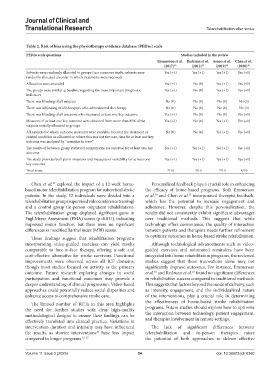
            Table 2. Risk of bias using the physiotherapy evidence database (PEDro) scale
            PEDro scale questions                                             Studies included in the review
                                                                    Emmerson et al.  Redzuan et al.  Asano et al.  Chen et al.
                                                                       (2017) 10   (2012) 13  (2019) 14  (2020) 15
            Subjects were randomly allocated to groups (in a crossover study, subjects were   Yes (+1)  Yes (+1)  Yes (+1)  Yes (+1)
            randomly allocated an order in which treatments were received)
            Allocation was concealed                                   Yes (+1)    No (0)    Yes (+1)  Yes (+1)
            The groups were similar at baseline regarding the most important prognostic   Yes (+1)  No (0)  Yes (+1)  Yes (+1)
            indicators
            There was blinding of all subjects                         No (0)      No (0)    No (0)    No (0)
            There was a blinding of all therapists who administered the therapy  No (0)  No (0)  No (0)  No (0)
            There was blinding of all assessors who measured at least one key outcome  Yes (+1)  No (0)  No (0)  Yes (+1)
            Measures of at least one key outcome were obtained from more than 85% of the   Yes (+1)  No (0)  Yes (+1)  Yes (+1)
            subjects initially allocated to groups
            All subjects for whom outcome measures were available received the treatment or   No (0)  No (0)  Yes (+1)  Yes (+1)
            control condition as allocated or, where this was not the case, data for at least one key
            outcome was analyzed by “intention to treat”
            The results of between-group statistical comparisons are reported for at least one key   Yes (+1)  Yes (+1)  Yes (+1)  Yes (+1)
            outcome
            The study provides both point measures and measures of variability for at least one   Yes (+1)  Yes (+1)  Yes (+1)  Yes (+1)
            key outcome
            Total score                                                 7/10        3/10      7/10     8/10

              Chen  et al.  explored the impact of a 12-week home-  Personalized feedback plays a crucial role in enhancing
                       15
            based motor telerehabilitation program for subcortical stroke   the efficacy of home-based programs. Both Emmerson
            patients. In the study, 52 individuals were divided into a   et al.  and Chen et al.  incorporated therapist feedback,
                                                                   10
                                                                                 15
            telerehabilitation group (supervised videoconference training)   which has the potential to increase engagement and
            and a control group (in-person outpatient rehabilitation).   adherence. However, despite this personalization, the
            The telerehabilitation group displayed significant gains in   results did not consistently exhibit significant advantages
            Fugl-Meyer Assessment (FMA) scores (p=0.011), indicating   over traditional methods. This suggests that while
            improved motor function, but there were no significant   technology offers convenience, the quality of interaction
            differences in modified Barthel index (MBI) scores.  between patients and therapists needs further refinement
              These findings suggest that rehabilitation programs   to optimize outcomes in home-based stroke rehabilitation.
            incorporating video-guided exercises can yield results   Although technological advancements such as video-
            comparable to face-to-face therapy, offering a safe and   guided exercises and automated reminders have been
            cost-effective alternative for stroke survivors. Functional   integrated into home rehabilitation programs, the reviewed
            improvements were observed across all ICF domains,   studies suggest that these innovations alone may not
            though most studies focused on activity as the primary   significantly improve outcomes. For instance, Emmerson
            outcome. Future research exploring changes in social   et al.  and Redzuan et al.  found no significant differences
                                                                   10
                                                                                   13
            participation and functional outcomes may provide a   in rehabilitation success compared to traditional methods.
            deeper understanding of clinical progression. Video-based   This suggests that factors beyond the mode of delivery, such
            approaches could potentially reduce social disparities and   as intensity, engagement, and the individualized nature
            enhance access to comprehensive stroke care.       of the interventions, play a crucial role in determining
              The  limited  number  of  RCTs  in this  area  highlights   the effectiveness of home-based stroke rehabilitation
            the  need  for  further  studies  with  clear,  high-quality   programs. Future studies should explore how to optimize
            methodological  designs  to  ensure  their  findings  can  be   the interaction between technology, patient engagement,
            effectively translated into clinical practice.  Variations  in   and therapist involvement in remote settings.
            intervention duration and intensity may have influenced   The  lack  of  significant  differences  between
            the results, as shorter interventions  have less impact   telerehabilitation  and  in-person  therapies  raises
                                          10
            compared to longer programs. 13-15                 the potential of both approaches to deliver effective

            Volume 11 Issue 3 (2025)                        54                               doi: 10.36922/jctr.8360

