


Page 28 - JCTR-11-4
P. 28
Journal of Clinical and
            Translational Research                                                  Propranolol as a treatment for HCC


            mechanisms is crucial for developing targeted therapies   HBV- and HCV-associated HCC. 42
            to prevent or treat HCC in patients with chronic HCV
            infection. 30                                      5. Role of propranolol in the prevention of
                                                               HCC
            4. Propranolol
                                                               Propranolol has been found to suppress the growth and
            4.1. Properties of propranolol                     proliferation of HCC cells by blocking beta-adrenergic
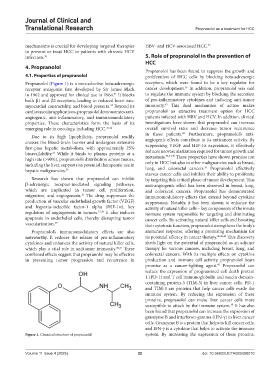
            Propranolol (Figure 1) is a non-selective beta-adrenergic   receptors, which were found to be a key regulator for
                                                                                36
            receptor antagonist first developed by Sir James Black   cancer development.  In addition, propranolol was said
            in 1962 and approved for clinical use in 1964.  It blocks   to regulate the immune system by blocking the secretion
                                                  31
            both β1 and β2 receptors, leading to reduced heart rate,   of pro-inflammatory cytokines and inducing anti-tumor
                                                                       43
            myocardial contractility, and blood pressure.  Beyond its   immunity.  This dual mechanism of action makes
                                                32
            cardiovascular applications, propranolol demonstrates anti-  propranolol an attractive treatment option for HCC
            angiogenic,  anti-inflammatory,  and  immunomodulatory   patients infected with HBV and HCV. In addition, clinical
            properties. These characteristics form the basis of its   investigations have shown that propranolol can increase
            emerging role in oncology, including HCC. 33,34    overall  survival rates  and decrease tumor recurrence
                                                               in these patients.  Furthermore, propranolol’s anti-
                                                                               42
              Due to its high lipophilicity, propranolol readily
            crosses the blood-brain barrier and undergoes extensive   angiogenic effects contribute to its anticancer activity. By
                                                               suppressing VEGF and HIF-1α expression, it effectively
            first-pass hepatic metabolism, with approximately 25%   reduces neovascularization required for tumor growth and
            bioavailability.  While it binds to plasma proteins at a   38,44,45
                       35
            high rate (>90%), propranolol’s distribution across tissues,   metastasis.   These properties have shown promise not
            including the liver, supports its potential therapeutic use in   only in HCC but also in other malignancies such as breast,
                                                                                        41
            hepatic malignancies. 35                           lung, and colorectal cancers.  Propranolol effectively
                                                               starves cancer cells and inhibits their ability to proliferate
              Research has shown that propranolol can inhibit   by targeting this critical phase of tumor development. This
            β-adrenergic  receptor-mediated  signaling  pathways,   anti-angiogenic effect has been observed in breast, lung,
            which are implicated in tumor cell proliferation,   and colorectal cancers. Propranolol has demonstrated
            migration, and angiogenesis.  The drug suppresses the   immunomodulatory effects that extend beyond cytokine
                                    36
            production of vascular endothelial growth factor (VEGF)   suppression.  Notably, it has been shown to enhance the
            and hypoxia-inducible factor-1 alpha (HIF-1α), key   activity of natural killer cells – key components of the innate
            regulators of angiogenesis in tumors. 37,38  It also induces   immune system responsible for targeting and eliminating
            apoptosis in endothelial cells, thereby disrupting tumor   cancer cells. By activating natural killer cells and boosting
            vascularization. 39                                their cytotoxic function, propranolol strengthens the body’s
              Propranolol’s immunomodulatory effects are  also   antitumor response, offering a promising mechanism for
            noteworthy. It reduces the release of pro-inflammatory   its potential efficacy in cancer therapy. 40,41,46  This discovery
            cytokines and enhances the activity of natural killer cells,   sheds light on the potential of propranolol as an adjunct
            which play a vital role in antitumor immunity. 40,41  These   therapy  for  various  cancers,  including  breast,  lung,  and
            combined effects suggest that propranolol may be effective   colorectal cancers. With its multiple effects on cytokine
            in  preventing  tumor  progression  and recurrence  in   production and immune cell activity, propranolol bears
                                                               promise as a cancer-fighting agent.  Propranolol can
                                                                                             47
                                                               reduce the expression of programmed cell death protein
                                                               1 (PD-1) and T cell immunoglobulin and mucin domain-
                                                               containing protein-3 (TIM-3) in liver cancer cells. PD-1
                                                               and TIM-3 are proteins that help cancer cells evade the
                                                               immune system. By reducing the expression of these
                                                               proteins, propranolol can make liver cancer cells more
                                                               susceptible to attack by the immune system.  It has also
                                                                                                   48
                                                               been found that propranolol can increase the expression of
                                                               granzyme B and interferon-gamma (IFN-γ) in liver cancer
                                                               cells. Granzyme B is a protein that helps to kill cancer cells,
                                                               and IFN-γ is a cytokine that helps to activate the immune
            Figure 1. Chemical structure of propranolol        system. By increasing the expression of these proteins,


            Volume 11 Issue 4 (2025)                        22                         doi: 10.36922/JCTR025080010

