


Page 49 - JCTR-11-4
P. 49
Journal of Clinical and
            Translational Research                                         Female are better in otoacoustic emissions tests


            A newborn with a normal bilateral response was accepted as   Table 1. Otoacoustic emissions of the general population
            a “pass.” Otherwise, the result was recorded as a “fail”. 8,9
                                                               Transient evoked otoacoustic   Gender   Total
            2.4. Statistical analysis                          emissions              Female  Male

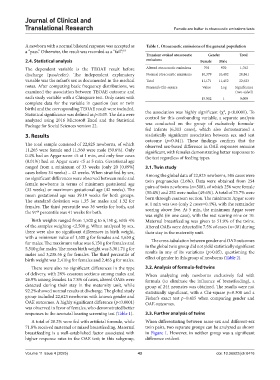
            The dependent variable is the TEOAE  result before   Altered otoacoustic emissions  792  970  1,762
            discharge (pass/refer). The independent explanatory   Normal otoacoustic emissions  10,379  10,482  20,861
            variable was the infant’s sex as documented in the medical   Total         11,171  11,452  22,623
            notes. After computing basic frequency distributions, we   Pearson’s Chi-square  Value  Log  Significance
            examined the association between TEOAE outcome and                                       (two-sided)
            each study variable with a Chisquare test. Only cases with                 15.002   1      0.000
            complete data for the variable in question (sex or twin
            birth) and the corresponding TEOAE result were included.                            2
            Statistical significance was defined as p<0.05. The data were   the association was highly significant (χ ,  p<0.0001). To
            analyzed using 2016 Microsoft Excel and the Statistical   control for this confounding variable, a separate analysis
            Package for Social Sciences version 22.            was conducted on the group of exclusively formula-
                                                               fed infants (6,313  cases), which also demonstrated a
            3. Results                                         statistically significant association between sex and test
                                                               outcome (p<0.041). These findings confirm that the
            The total sample consisted of 22,825 newborns, of which   observed sex-based difference in OAE responses remains
            11,265 were female and 11,560 were male (50.6%). Only   significant, with females demonstrating better responses to
            0.4% had an Apgar score <5 at 1 min, and only four cases   the test regardless of feeding types.
            (0.01%) had an Apgar score <5 at 5 min. Gestational age
            ranged from a minimum of 33  weeks (only 20 [0.09%]   3.1. Twin study
            cases below 34 weeks) – 42 weeks. When stratified by sex,   Among the global data of 22,825 newborns, 586 cases were
            no significant differences were observed between male and   twin  pregnancies  (2.6%).  Data  were  obtained  from  254
            female newborns in terms of minimum gestational age   pairs of twin newborns (n=508), of which 256 were female
            (33 weeks) or maximum gestational age (42 weeks). The   (50.4%) and 252 were males (49.6%). A total of 73.7% were
            mean gestational age was 39.19  weeks for both groups.
            The standard deviation was 1.35 for males and 1.32 for   born through cesarean section. The minimum Apgar score
            females. The third percentile was 36 weeks for both, and   at 1 min was two (only 2 cases=0.4%), with the remainder
            the 97  percentile was 41 weeks for both.          scoring above five. At 5 min, the minimum Apgar score
                 th
                                                               was eight (in one case), with the rest scoring nine or 10.
              Birth weights ranged from 1,500 g to 6,150 g, with 4%   Maternal breastfeeding was given to 51.9% of the twins.
            of the samples weighing <2,500 g. When analyzed by sex,   Altered OAEs were detected in 7.5% of cases (n=38) during
            there were also no significant differences in birth weight,   their stay in the maternity unit.
            with a minimum value of 1,500 g for females and 1,630 g
            for males. The maximum value was 6,150 g for females and   The cross-tabulation between gender and OAE outcomes
            5,510 g for males. The mean birth weight was 3,361.71 g for   in the global twin group did not yield statistically significant
            males and 3,238.56 g for females. The third percentile of   results in any of its variations (p>0.05), questioning the
            birth weight was 2,410 g for females and 2,465 g for males.  effect of gender in this group of newborns (Table 2).
              There were also no significant differences in the type   3.2. Analysis of formula-fed twins
            of delivery, with 28% cesarean sections among males and   When  analyzing  only  newborns  exclusively  fed  with
            26.9% among females. In 7.8% of cases, altered OAEs were   formula (to eliminate the influence of breastfeeding), a
            detected during their stay in the maternity unit, while   group of 244 neonates was obtained. The results were not
            92.2% showed normal results at discharge. The global study   statistically significant, with a Chi-square p=0.308 and a
            group included 22,623 newborns with known gender and   Fisher’s exact test  p=0.415 when comparing gender and
            OAE outcomes. A highly significant difference (p<0.0001)   OAE outcomes.
            was observed in favor of females, who demonstrated better
            responses to the neonatal hearing screening test (Table 1).  3.3. Further analysis of twins

              A total of 28.2% were fed with artificial formula, while   When differentiating between same-sex and different-sex
            71.8% received maternal or mixed breastfeeding. Maternal   twin pairs, two separate groups can be analyzed as shown
            breastfeeding is a well-established factor associated with   in Figure 1. However, in neither group was a significant
            higher response rates in the OAE test; in this subgroup,   difference evident.


            Volume 11 Issue 4 (2025)                        43                               doi: 10.36922/jctr.8416

