


Page 50 - JCTR-11-4
P. 50
Journal of Clinical and
            Translational Research                                         Female are better in otoacoustic emissions tests


            Table 2. Transient evoked otoacoustic emissions in twins
            Gender                 Transient evoked otoacoustic emissions in twins         Total
                              Altered otoacoustic emissions  Normal otoacoustic emissions
            Female                     16                     240                           256
            Male                       22                     230                           252
            Total                      38                     470                           508
            Chi square                Value                   Log               Asymptomatic    Exact significance
                                                                             significance (two‑sided)  (two‑sided)
            Pearson’s Chi-square      1.129                    1                   0.288
            Fisher’s exact test                                                                      0.315


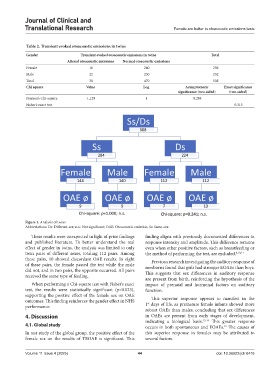
            Figure 1. Analysis of twins
            Abbreviations: Ds: Different-sex; n.s.: Not significant; OAE: Otoacoustic emission; Ss: Same-sex.
              These results were unexpected in light of prior findings   finding aligns with previously documented differences in
            and published literature. To better understand the real   response intensity and amplitude. This difference remains
            effect of gender in twins, the analysis was limited to only   even when other positive factors, such as breastfeeding or
            twin pairs of different sexes, totaling 112 pairs. Among   the method of performing the test, are excluded. 6,10,11
            these  pairs, 10  showed  discordant  OAE  results.  In  eight   Previous research investigating the auditory response of
            of these pairs, the female passed the test while the male   newborns found that girls had stronger EOAEs than boys.
            did not, and in two pairs, the opposite occurred. All pairs   This  suggests  that  sex  differences  in  auditory  response
            received the same type of feeding.
                                                               are present from birth, reinforcing the hypothesis of the
              When performing a Chi-square test with Fisher’s exact   impact of prenatal and hormonal factors on auditory
            test, the results were statistically significant (p<0.023),   function.
            supporting the positive effect of the female sex on OAE
            outcomes. This finding reinforces the gender effect in NHS   st  This superior response appears to manifest in the
            performance.                                       1  days of life, as premature female infants showed more
                                                               robust OAEs than males, concluding that sex differences
            4. Discussion                                      in OAEs are present from early stages of development,
                                                               indicating a biological  basis. 12-14  This  greater  response
            4.1. Global study                                  occurs in both spontaneous and EOAEs.  The causes of
                                                                                                15
            In our study of the global group, the positive effect of the   this superior response in females may be attributed to
            female sex on the results of TEOAE is significant. This   several factors.


            Volume 11 Issue 4 (2025)                        44                               doi: 10.36922/jctr.8416

