


Page 58 - JCTR-11-5
P. 58
Journal of Clinical and
            Translational Research                                          Metabolism of healthy and leukemic stem cells


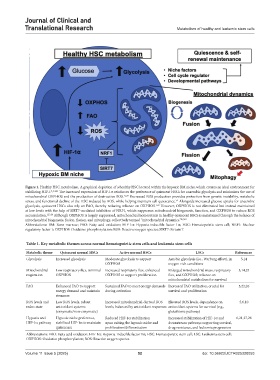
            Figure 1. Healthy HSC metabolism. A graphical depiction of a healthy HSC located within the hypoxic BM niche, which creates an ideal environment for
            stabilizing HIF-1 .   The increased expression of HIF-1α reinforces the preference of quiescent HSCs for anaerobic glycolysis and minimizes the use of
                       α 1,2,21
            mitochondrial OXPHOS and the production of destructive ROS. 1,2,21  Decreased ROS production provides protection from genetic instability, metabolic
            stress, and functional decline of the HSC induced by ROS, while helping maintain cell quiescence.  Alongside increased glucose uptake for anaerobic
                                                                            1,2
            glycolysis, quiescent HSCs also rely on FAO, thereby reducing reliance on OXPHOS.  However, OXPHOS is not eliminated but instead maintained
                                                                   5,22
            at low levels with the help of SIRT7-mediated inhibition of NRF1, which suppresses mitochondrial biogenesis, function, and OXPHOS to reduce ROS
            accumulation. 1,23,24  Although OXPHOS is largely suppressed, mitochondrial homeostasis in healthy quiescent HSCs is maintained through the balance of
            mitochondrial biogenesis, fusion, fission, and mitophagy, collectively termed “mitochondrial dynamics.” 5,9,10
            Abbreviations: BM: Bone marrow; FAO: Fatty acid oxidation; HIF-1α: Hypoxia-inducible factor 1α; HSC: Hematopoietic stem cell; NRF1: Nuclear
            regulatory factor 1; OXPHOS: Oxidative phosphorylation; ROS: Reactive oxygen species; SIRT7: Sirtuin 7.

            Table 1. Key metabolic themes across normal hematopoietic stem cells and leukemia stem cells
            Metabolic theme  Quiescent normal HSCs  Active normal HSCs              LSCs             References
            Glycolysis   Increased glycolysis  Moderate glycolysis to support   Aerobic glycolysis (i.e., Warburg effect), in   5,14
                                              OXPHOS                     oxygen-rich conditions
            Mitochondrial   Low respiratory flux, minimal  Increased respiratory flux, enhanced   Enlarged mitochondrial mass, respiratory   5,14,25
            respiration  OXPHOS               OXPHOS to support proliferation  flux, and OXPHOS; reliance on
                                                                         mitochondrial metabolism for survival
            FAO          Enhanced FAO to support   Sustained FAO to meet energy demands  Increased FAO utilization, crucial for   5,22,26
                         energy demand and maintain   during activation  survival and proliferation
                         stemness
            ROS levels and   Low ROS levels, robust   Increased mitochondrial-derived ROS   Elevated ROS levels, dependence on   5,6,10
            redox state  antioxidant systems   levels, balanced by antioxidant responses antioxidant systems for survival (e.g.,
                         (enzymatic/non-enzymatic)                       glutathione pathway)
            Hypoxia and   Hypoxic niche preference,   Reduced HIF-1α stabilization   Increased stabilization of HIF-1α and   6,21,27,28
            HIF-1α pathway  stabilized HIF-1α to maintain  upon exiting the hypoxic niche and   downstream pathways supporting survival,
                         quiescence           proliferation/differentiation  drug resistance, and leukemia progression
            Abbreviations: FAO: Fatty acid oxidation; HIF-1α: Hypoxia-inducible factor 1α; HSC: Hematopoietic stem cell; LSC: Leukemia stem cell;
            OXPHOS: Oxidative phosphorylation; ROS: Reactive oxygen species.


            Volume 11 Issue 5 (2025)                        52                         doi: 10.36922/JCTR025320053

