


Page 57 - JCTR-9-5
P. 57
Olatunji et al. | Journal of Clinical and Translational Research 2023; 9(5): 357-368   359
        development projects have become a key component in improving   research  [24]. This  disparity  needs  to  be  improved  for African
        research  capacity  in  Africa  [21].  These  projects  focus  on   researchers,  limiting  their  ability  to  compete  globally  and
        establishing or upgrading laboratory facilities, research centers,   collaborate effectively with international counterparts.
        and clinical trial sites, ensuring researchers have access to modern   Nevertheless, some shining examples of African-led research
        equipment, well-maintained facilities, and reliable resources. This   centers  have  made  substantial  contributions  to  the  scientific
        infrastructure support enables researchers to carry out their work   community. One such example is the South African Tuberculosis
        efficiently and effectively.                            Vaccine  Initiative (SATVI), a world-renowned research center
          Collaborations  with  international  partners  benefit  research   dedicated  to  developing  new  vaccines  for  tuberculosis  [25].
        capacity building in Africa [22]. These partnerships often provide   SATVI’s  pioneering  work  showcases  the  potential  for African-
        funding, technical assistance, and mentorship, further strengthening   led research to drive innovation and address critical  healthcare
        the research capabilities of African institutions [22]. The transfer   challenges that disproportionately affect the continent. Similarly,
        of  knowledge,  expertise,  and  technology  from  international   the African Institute for Mathematical Sciences (AIMS) stands as a
        partners to African researchers contributes to the overall growth   pan-African network of centers of excellence that provide advanced
        and advancement  of research in the region.  The ultimate  goal   education in mathematical sciences to students from across the
        of  these  collective  efforts  is  to  empower  African  researchers   continent [26]. By nurturing talent and fostering interdisciplinary
        and institutions to conduct impactful research that addresses the   collaborations,  AIMS  exemplifies  the  transformative  impact
        specific health challenges African populations face. By investing   of African-led initiatives in promoting research and knowledge
        in research infrastructure and capacity building, African countries   dissemination  within  and  beyond  the  region.  Despite  these
        can generate locally relevant evidence, inform health policies, and   notable  success stories, the  need  for cutting-edge  research
        improve health-care delivery. Consequently, these efforts lead to   facilities  and  advanced  technology  is  a  significant  barrier  to
        better health outcomes for African communities.         fully  unlocking  Africa’s  research  potential.  Addressing  this
                                                                scarcity requires targeted efforts from both local and international
        3. Challenges in Clinical and Translational Research in   stakeholders,  including  governments,  funding  agencies,  and
        Africa                                                  private institutions. By investing in developing and modernizing
                                                                research infrastructure, Africa can enable researchers to thrive and
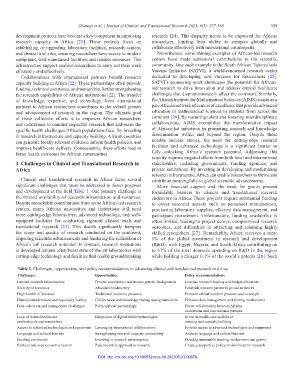
          Clinical  and  translational  research  in  Africa  faces  several   contribute meaningfully to global scientific advancements.
        significant challenges that must be addressed to foster progress   More  financial  support  and  the  need  for  grants  present
        and development in the field Table 1. One primary challenge is   formidable barriers to clinical and translational research
        the limited availability of research infrastructure and resources.   endeavors in Africa. These projects require substantial funding
        Despite remarkable contributions from some African-led research   to  cover  essential  aspects  such  as  personnel  remuneration,
        centers,  many  African  universities  and institutions  still  need   purchasing laboratory supplies, efficient data management, and
        more cutting-edge laboratories, advanced technology, and well-  participant  recruitment.  Unfortunately,  funding  availability  is
        equipped  facilities  for  conducting  rigorous  clinical  trials  and   often limited, leading to project delays, compromised research
        translational  research [23].  This  dearth  significantly  hampers   outcomes,  and  difficulties  in  attracting  and  retaining  highly
        the  scope  and  quality  of  research  conducted  on  the  continent,   skilled  researchers  [27].  Remarkably, Africa  receives  a  mere
        impeding scientific advancements and hindering the realization of   1%  of  the  global  investment  in  research  and  development
        Africa’s full research potential. In contrast, research institutions   (R&D), with Egypt, Nigeria, and South Africa contributing up
        in developed nations often boast state-of-the-art laboratories with   to 67% of the total domestic spending on R&D in the region
        cutting-edge technology and facilities that enable groundbreaking   while holding a meager 0.1% of the world’s patents [28]. Such

        Table 1. Challenges, opportunities, and policy recommendations in advancing clinical and translational research in Africa
        Challenges                       Opportunities                        Policy recommendations
        Limited research infrastructure  Diverse populations and unique genetic backgrounds  Increase research funding and budget allocation
        Scarcity of resources            Abundant biodiversity                Establish research partnerships and networks
        High burden of diseases          Traditional medicine practices       Promote ethical research practices and oversight
        Ethical considerations and regulatory hurdles  Collaboration and knowledge sharing among institutions  Enhance data management and sharing mechanisms
        Data collection and management challenges  Public-private partnerships  Foster collaboration between African
                                                                              institutions and international partners
        Lack of trained healthcare       Integration of digital health technologies  Invest in health-care workforce
        professionals and researchers                                         training and capacity building
        Access to advanced technologies and equipment Leveraging international collaborations  Provide access to advanced technologies and equipment
        Language and cultural barriers   Strengthening research capacity and training  Address language and cultural barriers
        Funding constraints              Investing in research infrastructure  Develop sustainable funding mechanisms and grants
        Political and socioeconomic factors  Patient-centric approach to research  Create a supportive policy environment for research

                                           DOI: http://dx.doi.org/10.18053/jctres.09.202305.23-00079

