


Page 59 - JCTR-9-5
P. 59
Olatunji et al. | Journal of Clinical and Translational Research 2023; 9(5): 357-368   361
        conduct high-quality research and provide the necessary resources
        for researchers and health-care professionals (Figure 1).
          Investing in research facilities and laboratories is paramount in
        advancing clinical and translational research capabilities in Africa.
        Beyond enabling cutting-edge  research, these state-of-the-art
        facilities are pivotal in attracting and retaining skilled researchers
        and scientists within the region. By providing researchers with
        an environment replete with advanced technologies and resources
        essential for their work, these facilities retain local talent, mitigate
        the adverse effects of brain drain, and cultivate a vibrant research
        community that augments scientific progress in Africa. Optimizing
        the impact of research facilities necessitates emphasizing capacity
        building and training initiatives [38]. The effective utilization of
        these resources is ensured by affording researchers, technicians,
        and  support  staff  access  to  specialized  training  in  operating
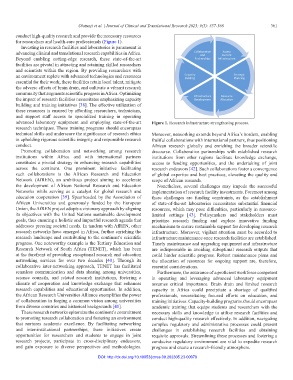
        advanced  laboratory  equipment  and  employing  state-of-the-art   Figure 1. Research infrastructure strengthening process.
        research techniques. These training programs should encompass
        technical skills and underscore the significance of research ethics   Moreover, networking extends beyond Africa’s borders, enabling
        in upholding rigorous scientific integrity and responsible research   fruitful collaborations with international partners, thus positioning
        conduct.                                                African  research  globally  and  enriching  the  broader  scientific
          Promoting  collaboration  and  networking  among  research   discourse.  Collaborative  partnerships  with  established  research
        institutions  within  Africa  and  with  international  partners   institutions  from  other  regions  facilitate  knowledge  exchange,
        constitutes a pivotal strategy in enhancing research capabilities   access  to  funding  opportunities,  and  the  undertaking  of  joint
        across  the  continent.  One  prominent  initiative  facilitating   research endeavors [42]. Such collaborations foster a convergence
        such collaborations  is the  African  Research  and  Education   of global expertise and best practices, elevating the quality and
        Network  (AfREN),  an  ambitious  project  aiming  to  accelerate   scope of African research.
        the  development  of  African  National  Research  and  Education   Nonetheless,  several  challenges  may  impede  the  successful
        Networks  while  serving  as  a  catalyst  for  global  research  and   implementation of research facility investments. Foremost among
        education  cooperation  [39].  Spearheaded  by  the Association  of   these challenges  are funding constraints, as the establishment
        African  Universities  and  generously  funded  by  the  European   of  state-of-the-art  laboratories  necessitates  substantial  financial
        Union, the AfREN project adopts a visionary approach by aligning   resources, which may pose difficulties, particularly in resource-
        its objectives with the United Nations sustainable development   limited  settings  [43].  Policymakers  and  stakeholders  must
        goals, thus ensuring a holistic and impactful research agenda that   prioritize  research  funding  and  explore  innovative  funding
        addresses pressing societal needs. In tandem with AfREN, other   mechanisms to ensure sustainable support for developing research
        research networks have emerged in Africa, further enriching the   infrastructure. Moreover, vigilant attention must be accorded to
        research landscape and contributing to the continent’s scientific   infrastructure maintenance once research facilities are established.
        progress. One noteworthy example is the Tertiary Education and   Timely maintenance and upgrading equipment and infrastructure
        Research  Network  of  South Africa  (TENET),  which  has  been   are  indispensable  in  avoiding  suboptimal  research  outputs  that
        at the forefront of providing exceptional research and education   could hinder scientific progress. Robust maintenance plans and
        networking  services  for  over  two  decades  [40]. Through  its   the  allocation  of  resources  for  ongoing  support  are,  therefore,
        collaborative inter-networking approach, TENET has facilitated   essential considerations.
        seamless communication  and data  sharing among universities,   Furthermore, the assurance of a proficient workforce competent
        science  councils, and related  research institutions,  fostering a   in  operating  and  leveraging  advanced  laboratory  equipment
        climate  of  cooperation  and  knowledge  exchange  that  enhances   assumes  critical  importance.  Brain  drain  and  limited  research
        research capabilities and educational opportunities. In addition,   capacity  in  Africa  could  precipitate  a  shortage  of  qualified
        the African Research Universities Alliance exemplifies the power   professionals,  necessitating  focused  efforts  on  education,  and
        of collaboration in forging a common vision among universities   training initiatives. Capacity-building programs should encompass
        from diverse countries and historical backgrounds [41].  academic training that equips students and researchers with the
          These research networks epitomize the continent’s commitment   necessary skills and knowledge to utilize research facilities and
        to promoting research collaboration and fostering an environment   conduct high-quality research effectively. In addition, navigating
        that  nurtures  academic  excellence.  By  facilitating  networking   complex  regulatory  and  administrative  processes  could  present
        and  inter-institutional  partnerships,  these  initiatives  create   challenges  in establishing research facilities  and obtaining
        opportunities  for  researchers  and  students  to  engage  in  joint   requisite approvals. Streamlining these processes and fostering a
        research  projects,  participate  in  cross-disciplinary  endeavors,   conducive regulatory environment are vital to expedite research
        and  gain  exposure  to  diverse  perspectives  and  methodologies.   progress and create a research-friendly atmosphere.
                                           DOI: http://dx.doi.org/10.18053/jctres.09.202305.23-00079

