


Page 30 - JCTR-9-6
P. 30
394                       Lubimova et al. | Journal of Clinical and Translational Research 2023; 9(6): 392-397
        Kolmogorov–Smirnov test, with no normal distribution identified.   biologics (n = 48; 63%). Ten patients (13%) received two biologics
        Description of quantitative variables was done with median and   and more, consequently.
        interquartile  range  (25%;  75%)  for  continuous  variables  and
        in terms of absolute  meanings  and percentages  for categorical   3.1.1. The predictors of the refused vaccination against
                                                                diphtheria
        variables. For comparison, the categorical variables Pearson’s χ
                                                           2
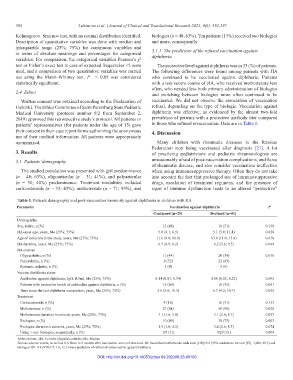
        test or Fisher’s exact test in case of expected frequencies <5 were   The protective level against diphtheria was in 33 (%) of patients.
        used, and a comparison of two quantitative variables was carried   The following differences were found among patients with JIA
        out  using  the  Mann–Whitney  test.  P     <   0.05  was  considered   who continued  to be vaccinated  against  diphtheria.  Patients
        statistically significant.                              with a less severe course of JIA, who received methotrexate less
                                                                often, who needed less both primary administration of biologics
        2.4. Ethics                                             and switching between  biologics  more often  continued  to be

          Written consent was obtained according to the Declaration of   vaccinated.  We  did  not  observe  the  association  of  vaccination
        Helsinki. The Ethics Committee of Saint Petersburg State Pediatric   refusal,  depending  on  the  type  of  biologic. Vaccination  against
        Medical  University  (protocol  number  9/2  from  September  2,   diphtheria  was  effective,  as  evidenced  by  the  almost  two-fold
        2019) approved this retrospective study’s protocol. All patients or   prevalence of patients with a protective antibody titer compared
        patients’ representatives (for patients under the age of 15) gave   to those who refused revaccination. Data are in Table 1.
        their consent in their case report forms authorizing the anonymous   4. Discussion
        use of their medical information. All patients were appropriately
        anonymized.                                                Many  children  with  rheumatic  diseases  in  the  Russian
                                                                Federation stop being vaccinated after diagnosis [21]. A  lot
        3. Results                                              of practicing pediatricians and pediatric rheumatologists are
        3.1. Patients’ demography                               unreasonably afraid of post-vaccination complications, and flares
                                                                of rheumatic disease, and also consider vaccination ineffective
          The studied population was presented with girl predominance   when using immunosuppressive therapy. Often they do not take
        (n  =  48;  63%),  oligoarticular  (n  =  31;  41%),  and  polyarticular   into account the fact that prolonged use of immunosuppressive
        (n  =  30;  40%)  predominance.  Treatment  modalities  included   drugs,  escalation  of  treatment  regimens,  and  the  presence  of
        corticosteroids (n = 33; 43%), methotrexate (n = 71; 93%), and   signs  of  immune  dysfunction  leads  to  an  altered  “protective”

        Table 1. Patients demography and post-vaccination immunity against diphtheria in children with JIA
        Parameter                                                       Vaccination against diphtheria           Р
                                                                 Continued (n=25)        Declined (n=51)
        Demography
        Sex, males, n (%)                                            12 (48)                16 (31)             0.158
        JIA onset age, years, Me (25%; 75%)                        5.0 (4.1; 6.5)         5.1 (3.0; 11.4)       0.820
        Age of inclusion in the study, years, Me (25%; 75%)       11.6 (9.8; 16.0)       13.8 (11.0; 15.8)      0.670
        JIA duration, years, Me (25%; 75%)                         6.5 (4.9; 8.2)         6.2 (3.6; 9.5)        0.699
        JIA courses
         Oligoarthritis, n (%)                                       11 (44)                20 (39)             0.678
         Polyarthritis, n (%)                                        8 (32)                 22 (43)
         Systemic arthritis, n (%)                                    1 (4)                  3 (6)
        Vaccine diphtheria status
         Antibodies against diphtheria, IgG, IU/ml, Me (25%; 75%)  0.14 (0.07; 0.34)     0.06 (0.02; 0.22)      0.695
         Patients with protective levels of antibodies against diphtheria, n (%)  15 (60)   18 (35)             0.041
         Time since the last diphtheria vaccination, years, Me (25%; 75%)  5.6 (3.6; 10.3)  6.7 (4.0; 10.7)     0.025
        Treatment
         Corticosteroids, n (%)                                      4 (16)                 16 (31)             0.153
         Methotrexate, n (%)                                         21 (84)                50 (98)             0.020
         Methotrexate duration treatment, years, Me (25%; 75%)     3.1 (1.6; 5.8)         5.1 (2.6; 8.7)        0.027
         Biologics, n (%)                                            10 (40)                38 (75)             0.003
         Biologics duration treatment, years, Me (25%; 75%)        1.9 (1.0; 4.1)         3.4 (2.6; 8.7)        0.674
         Using > one biologics, sequentially, n (%)                  1/9 (11)               9/29 (31)           0.009
        Abbreviations: JIA: Juvenile idiopathic arthritis; Me: Median
        Serious adverse events, as well as JIA flares in 3 months after vaccination were not observed. We found that methotrexate odds ratio [OR]=9.5 (95% confidence interval [CI]: 1,004; 90.3) and
        biologics OR=4.4 (95% CI: 1.6; 12.1) were predictors of refusal of revaccination against diphtheria.
                                          DOI: http://dx.doi.org/10.18053/jctres.09.202306.23-00103

