


Page 69 - MI-1-1
P. 69
Microbes & Immunity                                      Food chain milieus as a reserver for multidrug resistance


            bacterial cells and the acridine orange were selected, and   Table 2. Isolation of Pseudomonas aeruginosa and
            a loopful of the test organism in the tube(s) was streaked   distribution of MBL genes
            aseptically on MacConkey agar (MCA) plate(s) and CSA   Distribution                         n (/%)
            plates, which served as the recovery medium.  Incubation
                                                16
            was done overnight at 37°C in the incubator, and resultant   Source                         Poultry
            colonies were subcultured onto freshly prepared MCA and   Number of samples analyzed         65
            CSA plates to get pure strains of P. aeruginosa. Colonies of   Number of bacteria isolated   36 (55.5)
            P. aeruginosa that emanated from the recovery plates were   Phenotypic MBL detection       23 (63.9)
            checked for the loss of antibiotic resistance determinants   bla NDM                          -
            (genes) by investigating their susceptibility profile to   bla                             11 (47.8)
            any  of  the  carbapenems  (IPM  or  ETP)  and  their  MBL   bla IMP‑1                        -
            production ability using the MHT technique. The carriage   VIM
            of the antibiotic-resistant genes (ARGs) on the plasmid   bla IMP‑2                        6 (26.1)
            was  confirmed  in  P. aeruginosa  isolates  that  showed   Abbreviation: MBL: Metallo-beta-lactamase.
            susceptibility to previously ineffective antibiotics (IPM,
            ETP, or others) and was confirmed as non-MBL producers
            by the MHT technique.
            2.7. Multiple antibiotic resistance index (MARI)
            The MARI of the resistant  P. aeruginosa  isolates was
            determined according to a previously used protocol using
            the MARI formula.  Equation I was used to calculate the
                           17
            MARI for multidrug resistance profiling.
                        Number of antibiotics to which
                        resistence occured
            MARI=                                        (I)
                   Total number of antibiotics to which the
                   Pseudomonas  aeruginosa   isolates were tested


            3. Results                                         Figure  1.  Percentage of antibiotic susceptibility and resistance to
                                                               Pseudomonas aeruginosa.
            This study  investigated antimicrobial susceptibility
            patterns in  Pseudomonas-producing MBLs from poultry
            milieus in Enugu, Nigeria. Of the 65 cloacal swab samples
            bacteriologically analyzed for the isolation of Pseudomonas,
            36 isolates of  P. aeruginosa  (55.4%) were successfully
            recovered from cetrimide-selective agar plates (Table 2).
              The results of the antimicrobial susceptibility testing
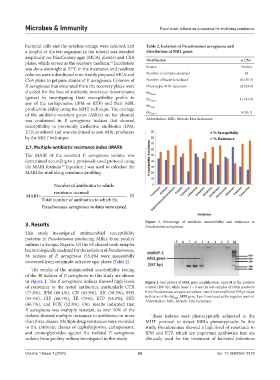
            of the 48 isolates of P. aeruginosa in this study are shown
            in Figure 1. The P. aeruginosa isolates showed high levels   Figure 2. Gel picture of MBL gene amplification. Lane M is the positive
            of resistance to the tested antibiotics, particularly CTX   control (100 bp), while lanes 1 – 9 are the test samples of DNA products
            (77.8%), IPM (69.4%), CN (63.9%), AK (58.3%), FOS   from Pseudomonas aeruginosa isolates. Lane 5 is an amplified DNA product
            (55.5%), CIP (66.7%), TE (75%), ETP (55.5%), SXT   indicative of the bla IMP-1  MBL gene. Lane 9 was used as the negative control.
            (66.7%), and FOX (52.8%). Our results indicated that   Abbreviation: MBL: Metallo-beta-lactamase.
            P. aeruginosa was multiply resistant, as over 50% of the
            isolates showed multiple resistance to antibiotics in more   These isolates were phenotypically subjected to the
            than three classes. Multiple drug resistances were recorded   MHT protocol to detect MBLs phenotypically. In this
            in the antibiotic classes of cephalosporins, carbapenems,   study, Pseudomonas showed a high level of resistance to
            and aminoglycosides against the isolated  P. aeruginosa   IPM  and  ETP,  which  are important  antibiotics  that  are
            isolates from poultry milieus investigated in this study.  clinically used for the treatment of bacterial infections


            Volume 1 Issue 1 (2024)                         63                               doi: 10.36922/mi.2319

