


Page 81 - MI-2-1
P. 81
Microbes & Immunity                                                    Childhood brucellosis in Saudi Arabia


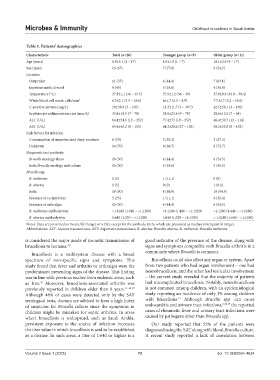
            Table 1. Patients’ demographics
            Characteristic                       Total (n=20)         Younger group (n=9)   Older group (n=11)
            Age (years)                          8.9±5.1 (1 – 17)     4.5±1.9 (1 – 7)       10.1±2.9 (8 – 17)
            Sex (male)                           13 (65)              7 (77.8)              6 (54.5)
            Location
             Outpatient                          11 (55)              4 (44.4)              7 (63.6)
             Inpatient medical ward              9 (45)               5 (55.6)              4 (36.4)
             Temperature (°C)                    37.9±1.1 (36 – 39.5)  37.9±1.2 (36 – 39)   37.9±0.9 (36.8 – 39.4)
             White blood cell count, cells/mm 3  6.7±2.1 (3.3 – 10.6)  6±1.7 (3.3 – 8.9)    7.7±2.7 (5.2 – 10.6)
             C-reactive protein (mg/L)           29±38.9 (3 – 169)    11.3±11.7 (3 – 39.7)  42.5±58.1 (3 – 169)
             Erythrocyte sedimentation rate (mm/h)  33.8±19.5 (7 – 70)  38.8±23.4 (9 – 70)  28.6±15.5 (7 – 44)
             ALT (U/L)                           64.4±54.6 (12 – 252)  77.4±73 (19 – 252)   46.4±39.7 (12 – 116)
             AST (U/L)                           65.8±43.2 (8 – 155)  64.3±28.6 (27 – 102)  58.3±53.8 (8 – 152)
            Risk factors for infection
             Consumption of unpasteurized dairy products  6 (30)      3 (33.3)              3 (27.3)
             Unknown                             14 (70)              6 (66.7)              8 (72.7)
            Diagnostic test positivity
             Brucella serology alone             10 (50)              4 (44.4)              6 (54.5)
             Both Brucella serology and culture  10 (50)              5 (55.6)              5 (45.5)
            Brucella spp.
             B. melitensis                       1 (5)                1 (11.1)              0 (0)
             B. abortus                          1 (5)                0 (0)                 1 (9.1)
             Both                                18 (90)              8 (88.9)              10 (90.9)
             Presence of co-infection            5 (25)               1 (11.1)              4 (36.4)
             Presence of arthralgia              10 (50)              4 (44.4)              6 (54.5)
             B. melitensis antibody titer        >1:1280 (1:640 – >1:1280)  >1:1280 (1:480 – >1:1280)  >1:1280 (1:640 – >1:1280)
             B. abortus antibody titer           1:640 (1:320 – >1:1280)  1:640 (1:320 – >1:1280)  > 1:1280 (1:640 – >1:1280)
            Notes: Data are presented as mean±SD (range) or n (%), except for the antibody titers, which are presented as median (interquartile range).
            Abbreviations: ALT: Alanine transaminase; AST: Aspartate transaminase; B. abortus: Brucella abortus, B. melitensis: Brucella melitensis.

            is considered the major mode of zoonotic transmission of   good indicator of the presence of the disease, along with
            brucellosis to humans. 2,5                         signs and symptoms compatible with Brucella arthritis in a
                                                               community where Brucella is common.
              Brucellosis is a multisystem disease with a broad
            spectrum  of non-specific  signs and  symptoms.  This   Brucellosis could also affect any organ or system. Apart
            study found that fever and arthritis or arthralgia were the   from two patients who had organ involvement – one had
            predominant presenting signs of the disease. This finding   neurobrucellosis, and the other had testicular involvement
            was in line with previous studies from endemic areas, such   – the current study revealed that the majority of patients
            as Iran.  Moreover, brucellosis-associated arthritis was   had uncomplicated brucellosis. Notably, neurobrucellosis
                  16
            previously reported in children older than 8  years. 11-13,17   is not common among children, with an epidemiological
            Although 48% of cases were detected only by the SAT   study reporting an incidence of only 1% among children
                                                                             11
            serological tests, doctors are advised to have a high index   with brucellosis.  Although  Brucella  spp. can cause
            of suspicion for  Brucella  culture since the symptoms in   endocarditis and urinary tract infections, 2,18,19  the reported
            children might be mistaken for septic arthritis. In areas   cases of rheumatic fever and urinary tract infections were
            where brucellosis is widespread, such as Saudi Arabia,   caused by pathogens other than Brucella spp.
            persistent exposure to the source of infection increases   Our study reported that 52% of the patients were
            the titer value in which brucellosis is said to be established   diagnosed using the SAT along with blood Brucella culture.
            as a disease. In such areas, a titer of 1:640 or higher is a   A  recent study reported a lack of correlation between


            Volume 2 Issue 1 (2025)                         73                               doi: 10.36922/mi.4634

