


Page 25 - MI-2-2
P. 25
Microbes & Immunity                                                     Genetic therapy with HSV-1 vectors


            disease through reactivation. However, the latent infection   2. Biological characteristics of HSV-1
            of viruses and the precise molecular mechanisms involved
            in  the  progression  from  latent  infection  to  reactivation   HSV is a typical representative of  Herpesviridae and
            are still unclear, and this mechanism may differ among   has two serotypes, HSV-1 and HSV-2. The HSV-1 viral
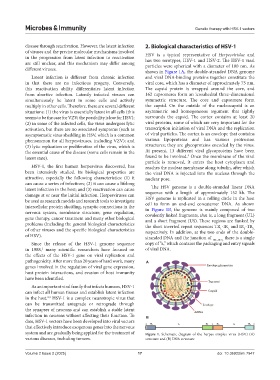
                                                               particles were spherical with a diameter of 100 nm. As
            different viruses.
                                                               shown in Figure 1A, the double-stranded DNA genome
              Latent infection is different from chronic infection   and viral DNA-binding proteins together constitute the
            in that there are no infectious progeny. Conversely,   viral core, which has a diameter of approximately 75 nm.
            this reactivation ability differentiates latent infection   The capsid protein is wrapped around the core, and
            from abortive infection. Latently infected viruses can   162 capsomeres form an icosahedral three-dimensional
            simultaneously be latent in some cells and actively   symmetric structure.  The core  and capsomere  form
            multiply in other cells. Therefore, there are several different   the capsid. On the outside of the nucleocapsid is an
            situations: (1) the virus is essentially latent in all cells (this   asymmetric and homogeneous tegument that tightly
            seems to be the case for VZV; the possibility is low for HSV);   surrounds the capsid. The cortex contains at least 20
            (2) in some of the infected cells, the virus undergoes lytic   viral proteins, some of which are very important for the
            activation, but there are no associated symptoms (such as   transcription initiation of viral DNA and the replication
            asymptomatic virus shedding in HSV, which is a common   of viral particles. The cortex is an envelope that contains
            phenomenon for all herpesviruses, including VZV); and   various lipoproteins and has various protrusion
            (3) lytic replication or proliferation of the virus, which is   structures; they are glycoproteins encoded by the virus.
            the essential cause of the disease (some cells remain in the   At present, 13 different viral glycoproteins have been
                                                                                 4
            latent state).                                     found to be involved.  Once the membrane of the viral
                                                               particle is removed, it enters the host cytoplasm and
              HSV-1, the first human herpesvirus discovered, has   reaches the nuclear membrane along tubulin, after which
            been intensively studied. Its biological properties are   the viral DNA is injected into the nucleus through the
            attractive, especially the following characteristics: (1) it   nuclear pore.
            can cause a series of infections; (2) it can cause a lifelong
            latent infection in the host; and (3) reactivation can cause   The HSV genome is a double-stranded linear DNA
            damage at or near the initial infection. Herpesviruses can   sequence with a length of approximately 152  kb. The
            be used as research models and research tools to investigate   HSV genome is replicated in a rolling circle in the host
            intercellular protein shuttling, synaptic connections in the   cell to form an end-end concatemer DNA. As shown
                                                               in  Figure  1B, the genome is mainly composed of two
            nervous system, membrane structure, gene regulation,   covalently linked fragments, that is, a long fragment (UL)
            gene therapy, cancer treatment and many other biological   and a short fragment (US). These regions are flanked by
            problems (including the general biological characteristics   the short inverted repeat sequences TR -IR  and IR -TR
                                                                                                         S
            of other viruses and the specific biological characteristics   respectively.  In  addition,  at  the  two  ends  of  the  double- S,
                                                                                               L
                                                                                                  L
            of HSV).                                           stranded DNA and the junction of    there is a single
                                                                                            IRL-IR S,
              Since the release of the HSV-1 genome sequence   copy of “a,” which contains the packaging and entry signals
            in 1988,  many scientific researchers have focused on   of viral DNA.
                   1
            the effects of the HSV-1 gene on viral replication and
            pathogenicity. After more than 20 years of hard work, many   A
            genes involved in the regulation of viral gene expression,
            host protein interactions, and evasion of host immunity
            have been identified.
              As an important viral family that infects humans, HSV-1
            can infect all human tissues and establish latent infection
            in the host.  HSV-1 is a complex neurotropic virus that
                     2,3
            can  be transmitted antegrade or retrograde through
            the synapses of neurons and can establish a stable latent
            infection in neurons without affecting their function. To   B
            date, HSV-1 vectors have been developed into viral vectors
            that effectively introduce exogenous genes into the nervous
            system and are gradually being applied for the treatment of   Figure  1.  Schematic diagram of the herpes simplex virus (HSV) (A)
            various diseases, including tumors.                structure and (B) DNA structure


            Volume 2 Issue 2 (2025)                         17                               doi: 10.36922/mi.7947

