


Page 169 - OR-1-3
P. 169
often fail to predict clinical outcomes due to oversimplified   organoids faithfully preserve patient-specific genetic
            cellular environments or interspecies discrepancies, leading   mutations,  ensuring  that  in vitro  therapeutic  responses
            to high attrition rates in clinical trials. 4     closely mirror those observed in vivo. Furthermore, they
                                                              provide a complex, multicellular microenvironment,
               Means  et al.  introduced an innovative approach that
                         5
            integrates PDOs with high-throughput ASO screening,   which is superior to traditional 2D cultures that often fail
                                                              to recapitulate the tissue-level effects of gene-targeting
            establishing  a  methodology  that  significantly  accelerates   therapies. An additional advantage of this approach is its
            the identification and validation of patient-specific ASO   efficiency and scalability. The study’s methodology reduces
            candidates. Published in  Nature under the title  Rapid   the ASO validation timeline to merely 6 weeks, a significant
            and Scalable Personalized ASO Screening in  PDOs, this   acceleration compared to conventional drug development
            study showcases a streamlined workflow whereby cardiac   pipelines. Such a rapid and adaptable workflow facilitates
            organoids  derived  from  Duchenne  muscular  dystrophy   the customization of gene therapies  at the individual
            (DMD) patient-specific induced pluripotent stem cells   level, expediting their transition into clinical applications.
            (iPSCs) effectively recapitulate the cardiac dysfunction   Beyond  ASO  therapeutics,  organoids  hold  immense
            characteristic  of  the  disease.  The  study  evaluates  ASO-  promise for screening an array of personalized treatments,
            mediated dystrophin restoration, demonstrating that PDO-  including small molecules, RNA-based drugs, and
            based  ASO  screening  constitutes  a  scalable  and  efficient   clustered regularly interspaced short palindromic repeats
            platform for precision medicine. This study establishes a rapid   (CRISPR)-Cas9  gene-editing  therapies.  Given  their  high
            and scalable platform for generating patient-derived cellular   fidelity in replicating disease phenotypes, organoids are
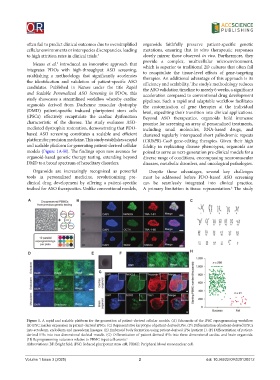
            models (Figure 1A-H). The findings open new avenues for   poised to serve as next-generation pre-clinical models for a
            organoid-based genetic therapy testing, extending beyond   diverse range of conditions, encompassing neuromuscular
            DMD to a broad spectrum of hereditary disorders.  diseases, metabolic disorders, and oncological pathologies.

               Organoids are increasingly recognized as powerful   Despite these advantages, several key challenges
            tools in personalized medicine, revolutionizing pre-  must be addressed before PDO-based ASO screening
            clinical drug development by offering a patient-specific   can be seamlessly integrated into clinical practice.
            testbed for ASO therapeutics. Unlike conventional models,   A  primary limitation is tissue representation.  The study
                                                                                                   6
             A                    B                                               C


             D                          E           F                             H


                                           G


            Figure 1. A rapid and scalable platform for the generation of patient-derived cellular models. (A) Schematic of the iPSC reprogramming workflow.
            (B) iPSC marker expression in patient-derived iPSCs. (C) Representative karyotype of patient-derived iPSs. (D) Differentiation of patient-derived iPSCs
            into ectoderm, endoderm and mesoderm lineages. (E) Embryoid body formation using patient-derived iPSs (patient 1). (F) Differentiation of patient-
            derived iPSs into two-dimensional skeletal muscle. (G) Differentiation of patient-derived iPSs into three-dimensional cardiac and brain organoids.
            (H) Reprogramming outcomes relative to PBMC input cell counts. 5
            Abbreviations: BF: Bright field; iPSC: Induced pluripotent stem cell; PBMC: Peripheral blood mononuclear cell.


            Volume 1 Issue 3 (2025)                         2                            doi: 10.36922/OR025120012

