


Page 75 - OR-1-3
P. 75
functional maturation of MSK organoids. For example,   Tsigkou et al.  seeded collagen-fibronectin gel containing
                                                                         229
            ECs in skeletal muscle not only provide blood supply but   HUVECs  and  human  MSCs  (hMSCs)  on  the  scaffold.
            also regulate the alignment and contractile function of   Surprisingly, hMSCs assumed the role of perivascular
            muscle fibers by secreting growth factors, such as vascular   cells and acted as effective stabilizers of the engineered
            endothelial growth factor (VEGF) and insulin-like growth   vessels, allowing the HUVECs to form tubular structures
            factor (IGF)-1. 223,224  In addition, in the skeletal system,   7 days after scaffold implantation in vivo. Although some
            osteogenesis  is  associated  with  a  specific  capillary  EC   human-derived HUVECs  remained  after 5  months,  the
            subtype, termed type  H. 218,225  This subtype shows high   vascular system of  most  grafts  had been remodeled  by
            expression of the markers CD31 and endomucin, which are   host rat cells. This study confirms the ability of HUVECs
            present in the epiphysis and endosteum of postnatal long   to function as organoid vascular building cells and to
            bones. In addition to inducing vascular growth, type H ECs   form connections with blood vessels in vivo to accomplish
            also act on osteogenic progenitor cells through molecular   nutrient transport. These studies offer a new strategy for
            signaling.  Therefore, the introduction and integration of   inducing angiogenesis in vitro, promoting a significant step
                    226
            a functional vascular network into MSK organoid cultures   forward for vascularized organoids, which can effectively
            could  address  the challenge of  organoid  undernutrition   overcome the challenge of oxygen and nutrient diffusion, as
            and promote functional maturation of organoids.   well as expand the size and scale of organoid culture.
               Recently, researchers have made some attempts,   5.1.2. Incomplete innervation
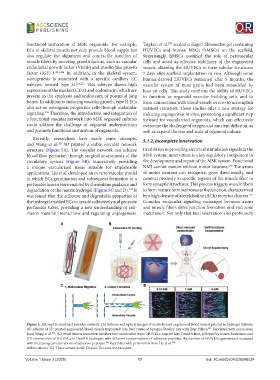
            and Wang  et al. 227  3D printed a stable vascular network
            structure (Figure  5A). The vascular network can achieve   In addition to providing electrical stimulation signals in the
            blood flow perfusion through surgical anastomosis of the   MSK system, innervation is a key regulatory component in
            circulatory system (Figure  5B), innovatively providing   the development and repair of the MSK system. Functional
                                                                                                  230
            a unique vascularized tissue suitable for implantable   NMJ cannot mature without motor neurons.  The axons
            applications. Liu et al. developed an in vitro vascular model   of motor neurons can recognize, grow directionally, and
            in which ECs germination and subsequent formation of a   connect precisely to specific regions of the muscle fiber to
            perfusable lumen were enabled by chemokine guidance and   form synaptic structures. This process triggers muscle fibers
            degradation of the matrix hydrogel (Figure 5C and D).  It   to form mature terminal zones at the junction, characterized
                                                        228
            was found that the adhesive and degradable properties of   by a high density of acetylcholine (ACh) receptor clusters.
                                                                                                           231
            the hydrogel enabled ECs to invade collectively and generate   Complex molecular signaling exchanges between axons
            perfusable tubes, providing a new understanding of cell-  and muscle fibers drive junction formation and end zone
            matrix material interactions and regulating angiogenesis.   maturation. Not only that but innervation also profoundly

                           A                   B


                           C                                  D


            Figure 5. Attempt to construct vascular network. (A) Scheme and optical images of multichannel engineered blood vessels printed in hydrogel hybrids;
            (B) scheme of 3D printed engineered blood vessels implanted into liver tissue of Sprague-Dawley rats with liver failure.  Reprinted with permission
                                                                                          227
            from Wang et al. ; (C) vessel lumen formation involves two consecutive steps: HUVECs migrate into DexMA first, followed by lumen formation; and
                       227
            (D) intervention of HUVECs in DexMA hydrogels with different concentrations of adhesion peptides, the number of HUVECs germinated increased
            with increasing concentrations of adhesion peptides.  Reprinted with permission from Liu et al. 228
                                              228
            Abbreviations: 3D: Three-dimensional; Dexma: Dextran methacrylate.
            Volume 1 Issue 3 (2025)                         17                           doi: 10.36922/OR025280024

