


Page 70 - OR-1-3
P. 70
A                                      B


             C
                                           D                               E


             F                                       G


             H                 I                    J                           K


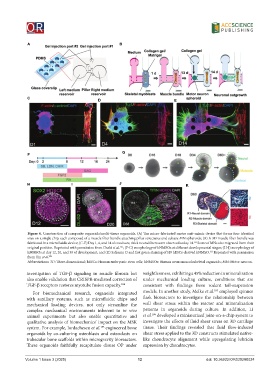
             Figure 4. Construction of composite organoids/multi-tissue organoids. (A) The micro-fabricated motor unit-mimic device that forms four identical
             sites on a single chip, each composed of a muscle fiber bundle attaching pillar structures and culture MN spheroids; (B) A 3D muscle fiber bundle was
             fabricated in a microfluidic device; (C-E) Day 1, 4, and 14 of coculture, thick neural fibers were observed at day 14.  Some of MNs also migrated from their
                                                                                   165
             original position. Reprinted with permission from Osaki et al. ; (F-G) morphology of hNMSOs at different developmental stages; (H-J) morphology of
                                                    165
             hNMSOs at day 12, 20, and 38 of development; and (K) Safranin O and fast green staining of H9 hESCs-derived hNMSO.  Reprinted with permission
                                                                                          121
             from Yin et al. 121
             Abbreviations: 3D: Three-dimensional; hESCs: Human embryonic stem cells; hNMSOs: Human neuromusculoskeletal organoids; MN: Motor neuron.
            investigation of TGF-β signaling in muscle fibrosis but   weightlessness, exhibiting a 45% reduction in mineralization
            also enable validation that CRISPR-mediated correction of   under  mechanical loading culture, conditions that are
            TGF-β receptors restores myotube fusion capacity. 184  consistent with findings from rodent tail-suspension
                                                                                            185
               For biomechanical research, organoids integrated   models. In another study, Melke et al.  employed spinner
            with auxiliary systems, such as microfluidic chips and   flask bioreactors to investigate the relationship between
            mechanical loading devices, not only streamline the   wall shear stress within the reactor and mineralization
            complex mechanical environments inherent to  in vivo   patterns in organoids during culture. In addition, Li
                                                                  186
            animal experiments but also enable quantitative and   et al.  developed a miniaturized joint-on-a-chip system to
            qualitative analysis of biomechanics’ impact on the MSK   investigate the effects of fluid shear stress on 3D cartilage
            system. For example, Iordachescu et al.  engineered bone   tissue. Their findings revealed that fluid flow-induced
                                            133
            organoids by co-culturing osteoblasts and osteoclasts on   shear stress applied to the 3D constructs stimulated native-
            trabecular bone scaffolds within microgravity bioreactors.   like chondrocyte alignment while upregulating lubricin
            These  organoids faithfully  recapitulate disuse  OP under   expression by chondrocytes.


            Volume 1 Issue 3 (2025)                         12                           doi: 10.36922/OR025280024

