


Page 61 - TD-1-1
P. 61
Tumor Discovery                                                     Anti-PD1 for advanced pancreatic cancer


            A                                                    Fortunately, immunotherapy has gradually transformed
                                                               the therapeutic landscape for various solid tumors, such
                                                               as renal cell cancer, lung cancer, melanoma, and others. In
                                                               the field of immunotherapy, many clinical trials are being
                                                               performed to test the efficacy of immunotherapy in PC, for
                                                               example, the application of adoptive cell transfer, cancer
                                                               vaccines, ICI, and combinations with molecular targeted
                                                               agents or chemoradiotherapy. It is reported that PD-L1
                                                               expression is a prognostic response to immunotherapy in
                                                               PC, so anti-PD-1 immunotherapy holds promise in the
            B                                                  future treatment of PC. In addition, the combination of
                                                               cytotoxic drugs and immunotherapy seems to result in a
                                                               synergistic effect .
                                                                            [12]
                                                                 In this case report, we present our experiences
                                                               in treating a PC patient using surgical resection,
                                                               chemotherapy, molecular targeted medicine, and anti-PD1
                                                               immunotherapy. The combined treatment modalities
                                                               turned out to be successful in extending the patient’s
                                                               survival time to more than 6  years since diagnosis.
                                                               That being said, the application of immunotherapy in
            C
                                                               combination with different therapeutic strategies might
                                                               offer a favorable treatment option for PC patients.
                                                                 However, the current treatment modalities for the
                                                               treatment-associated toxicity of immunotherapy-based
                                                               approaches  are  limited.  Even  though  immunotherapy
                                                               can significantly improve cancer pain and provide an
                                                               overall favorable clinical and survival benefit, the use
                                                               of immunotherapy for PC still needs to be further
                                                                        [13]
                                                               investigated .
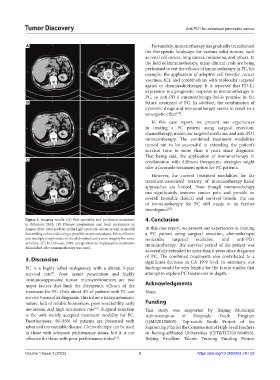
            Figure 1. Imaging results. (A) Post-operative and peritoneal metastasis   4. Conclusion
            in February 2018. (B) Disease progression and local recurrence  in
            August 2018. New nodules in the right paracolic sulcus as well as medial   In this case report, we present our experiences in treating
            descending colon, indicating a possible severe metastasis. Pelvic effusion   a  PC patient  using surgical resection, chemotherapy,
            and multiple lymph nodes in the abdominal cavity were roughly the same   molecular  targeted  medicine,  and  anti-PD1
            as before. (C) In February 2019, intraperitoneal implantation metastasis   immunotherapy. The survival period of the patient was
            diminished after immunotherapy was used.
                                                               successfully extended to more than 6 years since diagnosis
                                                               of PC. The combined treatments also contributed to a
            3. Discussion                                      significant decrease in CA 19-9 level. In summary, our
            PC is a highly lethal malignancy with a dismal 5-year   findings would be very helpful for the future studies that
            survival rate . Poor tumor penetration and highly   attempt to explore PC treatments in-depth.
                       [9]
            immunosuppressive tumor microenvironment are two
            major  factors that  limit  the therapeutic efficacy of  the   Acknowledgments
            treatment for PC. Only about 4% of patients with PC can   None.
            survive 5 years after diagnosis. This is due to its asymptomatic
            nature, lack of reliable biomarkers, poor resectability, early   Funding
                                         [10]
            metastasis, and high recurrence rate . Surgical resection   This study was supported by Beijing Municipal
            is the only widely accepted treatment modality for PC.   Administration  of  Hospitals’  Youth  Program
            Fuerthermore, 80–85% of patients are presented with   (QMS20180805), Top-notch Youth Project of the
            advanced unresectable disease. Chemotherapy can be used   Supporting Plan for the Construction of High-level Teachers
            in those with adequate performance status, but it is not   in Beijing-affiliated Universities (CIT&TCD201904093),
            effective for those with poor performance status .  Beijing Excellent Talents Training Funding Project
                                                  [11]

            Volume 1 Issue 1 (2022)                         3                        https://doi.org/10.36922/td.v1i1.52

