


Page 56 - TD-1-1
P. 56
Tumor Discovery                                              Dual-targeting of cancer receptors by nanoparticles


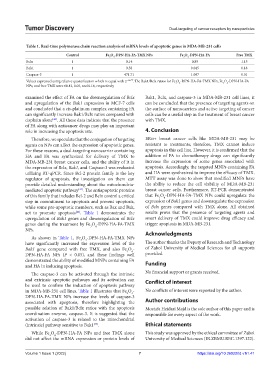
            Table 1. Real‑time polymerase chain reaction analysis of mRNA levels of apoptotic genes in MDA‑MB‑231 cells
                             Control          Fe O ‑DPN‑HA‑FA‑TMX NPs         Fe O ‑DPN‑HA‑FA         Free TMX
                                                3  4                           3  4
            Bclx               1                       0.14                        0.89                 1.15
            Bak1               1                       9.58                       0.045                 0.18
            Caspase-3          1                      471.71                      1.097                 0.01
            Values expressed using relative quantification which is equal with 2 -∆∆CT . The Bak1/Bclx ratios for Fe O -DPN-HA-FA-TMX NPs, Fe O -DPN-HA-FA
                                                                                                 4
                                                                             4
                                                                            3
                                                                                                3
            NPs, and free TMX were 68.43, 0.05, and 0.16, respectively
            examined the effect of FA on the downregulation of Bclx   Bak1, Bclx, and caspase-3 in MDA-MB-231 cell lines, it
            and upregulation of the Bak1 expression in MCF-7 cells   can be concluded that the presence of targeting agents on
            and concluded that a cis-platinum complex containing FA   the surface of nanocarriers and active targeting of cancer
            can significantly increase Bak1/Bclx ratios compared with   cells can be a useful step in the treatment of breast cancer
            cisplatin alone . All these data indicate that the presence   with TMX.
                       [41]
            of FA along with anticancer drugs may play an important
            role in increasing the apoptosis rate.             4. Conclusion
              Therefore, we speculate that the conjugation of targeting   ERα+ breast cancer cells like MDA-MB-231 may be
            agents on NPs can affect the expression of apoptotic genes.   resistant to treatments; therefore, TMX cannot induce
            For these reasons, a dual-targeting nanocarrier containing   apoptosis in this cell line. However, it is confirmed that the
            HA and FA was synthesized for delivery of TMX to   addition of FA to chemotherapy drugs can significantly
            MDA-MB-231 breast cancer cells, and the ability of it in   increase  the  expression  of  some  genes  associated  with
            the expression of Bclx, Bak1, and Caspase-3 was evaluated   apoptosis. Accordingly, the targeted MNPs containing FA
            utilizing RT-qPCR. Since Bcl-2 protein family is the key   and HA were synthesized to improve the efficacy of TMX.
            regulator of apoptosis, the investigation on them can   MTT assay was done to show that modified MNPs have
            provide detailed understanding about the mitochondria-  the ability to reduce the cell viability of MDA-MB-231
            mediated apoptotic pathway . The antiapoptotic proteins   breast cancer cells. Furthermore, RT-PCR demonstrated
                                  [42]
            of this family that includes Bcl-2 and Bclx control a critical   that Fe O -DPN-HA-FA-TMX NPs could upregulate the
                                                                       4
                                                                     3
            step in commitment to apoptosis and prevent apoptosis,   expression of Bak1 genes and downregulate the expression
            while some pro-apoptotic members, such as Bax and Bak,   of  Bclx genes compared with TMX alone. All obtained
            act to promote apoptosis .  Table 1 demonstrates the   results prove that the presence of targeting agents and
                                 [43]
            upregulation of  Bak1 genes and downregulation of  Bclx   smart delivery of TMX could improve drug efficacy and
            genes during the treatment by Fe O -DPN-HA-FA-TMX   trigger apoptosis in MDA-MB-231.
                                       3
                                          4
            NPs.                                               Acknowledgments
              As shown in  Table 1, Fe O -DPN-HA-FA-TMX  NPs
                                   3
                                     4
            have  significantly  increased  the  expression  level  of  the   The author thanks the Deputy of Research and Technology
            Bak1 gene compared with free TMX, and also Fe O -  of Zabol University of Medical Sciences for all supports
                                                         4
                                                       3
            DPN-HA-FA NPs (P < 0.05), and these findings well   provided.
            demonstrated the ability of modified MNPs containing FA   Funding
            and HA in inducing apoptosis.
              The caspase-3 can be activated through the intrinsic   No financial support or grants received.
            and extrinsic apoptotic pathways and its activation can   Conflict of interest
            be used to confirm the induction of apoptosis pathway
            in MDA-MB-231 cell lines. Table 1 illustrates that Fe O -  No conflicts of interest were reported by the author.
                                                       3
                                                         4
            DPN-HA-FA-TMX NPs increase the levels of caspase-3
            associated  with  apoptosis,  therefore  highlighting  the   Author contributions
            possible relation of Bak1/Bclx ratios with the apoptosis   Mostafa Heidari Majd is the sole author of this paper and is
            coordination enzyme, caspase-3. It is suggested that the   responsible for every aspect of the work.
            activation  of  caspase-3  is  related  to  the  mitochondrial
            (intrinsic) pathway sensitive to Bak1 .            Ethical statements
                                         [44]
              While Fe O -DPN-HA-FA NPs and free TMX alone     This study was approved by the ethical committee of Zabol
                      3
                        4
            did not affect the mRNA expression or protein levels of   University of Medical Sciences (IR.ZBMU.REC.1397.122).
            Volume 1 Issue 1 (2022)                         7                        https://doi.org/10.36922/td.v1i1.41

