


Page 55 - TD-1-1
P. 55
Tumor Discovery                                              Dual-targeting of cancer receptors by nanoparticles


            drug release may be due to the interaction between the   It had been observed that all concentrations of free
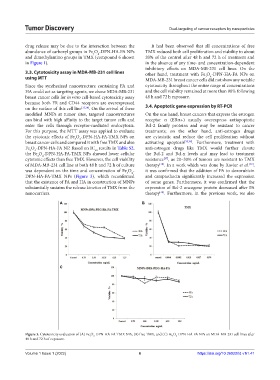
            abundance of carboxyl groups in Fe O -DPN-HA-FA NPs   TMX reduced both cell proliferation and viability to about
                                         3
                                           4
            and dimethylamino groups in TMX (compound 6 shown   20% of the control after 48 h and 72 h of treatment and
            in Figure 1).                                      in the absence of any time- and concentration-dependent
                                                               inhibitory effects on MDA-MB-231 cell lines. On the
            3.3. Cytotoxicity assay in MDA-MB-231 cell lines   other hand, treatment with Fe O -DPN-HA-FA NPs on
                                                                                        3
                                                                                          4
            using MTT                                          MDA-MB-231 breast cancer cells did not show any notable
            Since the synthesized nanostructure containing FA and   cytotoxicity throughout the entire range of concentrations
            HA could act as targeting agents, we chose MDA-MB-231   and the cell viability remained at more than 90% following
            breast cancer cells for in vitro cell-based cytotoxicity assay   48 h and 72 h exposure.
            because both FR and CD44 receptors are overexpressed
            on the surface of this cell line [33,34] . On the arrival of these   3.4. Apoptotic gene expression by RT-PCR
            modified MNPs at tumor sites, targeted nanostructures   On the one hand, breast cancers that express the estrogen
            can bind with high affinity to the target tumor cells and   receptor  α (ERα+) usually overexpress antiapoptotic
            enter the cells through receptor-mediated endocytosis.   Bcl-2 family proteins and may be resistant to cancer
            For this purpose, the MTT assay was applied to evaluate   treatments; on the other hand, anti-estrogen drugs
            the cytotoxic effects of Fe O -DPN-HA-FA-TMX NPs on   are cytostatic and reduce  the cell proliferation without
                                 3
                                   4
            breast cancer cells and compared it with free TMX and also   activating apoptosis [35,36] . Furthermore, treatment with
            Fe O -DPN-HA-FA NP. Based on IC  results in Table S2,   anti-estrogen drugs  like TMX would  further  elevate
                4
              3
                                         50
            the Fe O -DPN-HA-FA-TMX NPs showed lower cellular   the  Bcl-2  and  Bcl-x  levels  and  may  lead  to  treatment
                 3
                   4
            cytotoxic effects than free TMX. However, the cell viability   resistance , as 20–30% of tumors are resistant to TMX
                                                                       [37]
            of MDA-MB-231 cell line at both 48 h and 72 h of culture   therapy . In a work which was done by Xavier et al. ,
                                                                     [38]
                                                                                                           [39]
            was dependent on the time and concentration of Fe O -  it was confirmed that the addition of FA to doxorubicin
                                                       3
                                                         4
            DPN-HA-FA-TMX NPs (Figure  3), which reconfirmed   and camptothecin significantly increased the expression
            that the existence of FA and HA in construction of MNPs   of some genes. Furthermore, it was confirmed that the
            substantially sustains the release kinetics of TMX from the   expression of Bcl-2 oncogene protein decreased after FA
            nanocarriers.                                      therapy . Furthermore, in the previous work, we also
                                                                     [40]
                           A                                 B


                           C


            Figure 3. Cytotoxicity evaluation of (A) Fe O -DPN-HA-FA-TMX NPs, (B) free TMX, and (C) Fe O -DPN-HA-FA NPs on MDA-MB-231 cell lines after
                                                                            4
                                                                          3
                                       3
                                         4
            48 h and 72 h of exposure.
            Volume 1 Issue 1 (2022)                         6                        https://doi.org/10.36922/td.v1i1.41

