


Page 54 - TD-1-1
P. 54
Tumor Discovery                                              Dual-targeting of cancer receptors by nanoparticles


            20 s, and 72°C for 20 s, and finally melt curve stage at 95°C   A         B
            for 15 s, 60°C for 60 s, and 95°C for 15 s. Each sample was
            assayed in duplicate, and the average cycle threshold (CT)
            value was normalized to the housekeeping gene GAPDH
            and the fold change expression was calculated by ΔΔCT
            method .
                  [26]
            3. Results and discussion

            3.1. Characterization of Fe O -DPN-HA-FA
                                   3  4
            As described in our previous work, the surface of Fe O
                                                          4
                                                        3
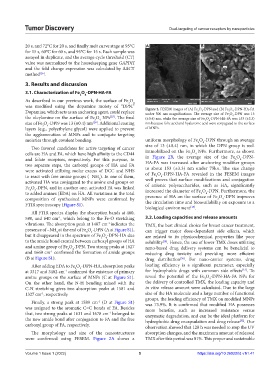
            was modified using the dopamine moiety of “DPN.”   Figure 2. FESEM images of (A) Fe O -DPN and (B) Fe O -DPN-HA-FA
            Dopamine, which acts as an anchoring agent, could replace   under 500  nm magnifications. The average size of Fe O -DPN was 13
                                                                                                  3
                                                                                     3
                                                                                       4
                                                                                                    4
                                                                                                  3
                                                                                                    4
            the oleylamine on the surface of Fe O  NPs . The final   (±0.4) nm, while the average size of Fe O -DPN-HA-FA was 153 (±3.3)
                                                [27]
                                         3
                                           4
                                                                                          4
                                                                                        3
            size of Fe O -DPN was 13 (±0.4) nm . Additional coating   nm because folic acid and hyaluronic acid were conjugated to the surface
                                         [28]
                   3
                     4
            layers (e.g., polyethylene glycol) were applied to prevent   of MNPs.
            the agglomeration of MNPs and to conjugate targeting
            moieties through covalent bonding.                 uniform morphology of Fe O -DPN through an average
                                                                                     3
                                                                                       4
              Two favored candidates for active targeting of cancer   size of 13 (±0.4) nm, in which the DPN group is well
            cells are HA and FA, which have high affinity to the CD44   immobilized on the Fe O  NPs. Furthermore, as shown
                                                                                    4
                                                                                  3
            and folate receptors, respectively. For this purpose, in   in  Figure  2B, the average size of the Fe O -DPN-
                                                                                                       4
                                                                                                     3
            two separate steps, the carboxyl groups of HA and FA   HA-FA was increased after anchoring modifier groups
            were  activated  utilizing  molar  excess  of DCC and  NHS   to about 153 (±3.3) nm under 75k×. The size change
            to react with free amine groups (−NH ). In one of them,   of Fe O -DPN-HA-FA revealed in the FESEM images
                                                                     4
                                                                   3
                                           2
            activated HA was conjugated to the amine end groups on   well proves that surface modifications and conjugation
            Fe O -DPN, and in another one, activated FA was linked   of anionic polysaccharides, such as HA, significantly
                4
              3
            to added amines (EDA) on HA. All variations in the total   increased the diameter of Fe O -DPN. Furthermore, the
                                                                                      3
                                                                                         4
            composition of  synthesized MNPs  were  confirmed  by   presence of HA on the surface of Fe O -DPN improves
                                                                                             3
                                                                                                4
            FTIR spectroscopy (Figure S1).                     the circulation time and bioavailability on exposure to a
                                                               biological environment [29] .
              All FTIR spectra display the absorption bands at 460,
            580, and 640 cm , which belong to the Fe-O stretching   3.2. Loading capacities and release amounts
                          -1
                                               -1
            vibrations. The absorption peak at 1487 cm indicates the   TMX, the best clinical choice for breast cancer treatment,
            presence of –NH at the end of Fe O -DPN (A at Figure S1),   can trigger major dose-dependent side effects, which
                                      3
                         2
                                        4
            but it disappeared in the spectrum of Fe O -DPN-HA due   are  related  to  its  physicochemical  properties  like  poor
                                            3
                                              4
            to the amide bond created between carboxyl groups of HA   solubility . Hence, the use of lower TMX doses utilizing
                                                                      [18]
            and amine group of Fe O -DPN. Two strong peaks at 1627   nano-based drug delivery systems can be beneficial to
                              3
                                4
            and 1669 cm  confirmed the formation of amide groups   reducing drug toxicity and providing more efficient
                      -1
            (B at Figure S1).                                  drug distribution . For nano-carrier systems, drug
                                                                              [30]
              After adding EDA to Fe O -DPN-HA, absorption peaks   loading efficiency is a significant parameter, especially
                                   4
                                 3
                                                                                                        [31]
            at 3317 and 3402 cm  confirmed the existence of primary   for hydrophobic drugs with common side effects . To
                            -1
            amine groups on the surface of MNPs (C at Figure S1).   reveal the potential of the Fe O -DPN-HA-FA NPs for
                                                                                        3
                                                                                          4
            On the other hand, the N-H bending mixed with the   the delivery of controlled TMX, the loading capacity and
            C-N stretching gives two absorption peaks at 1581 and   in vitro release amount were calculated. Due to the large
            1327 cm , respectively.                            size of the HA molecule and a large number of functional
                   -1
                                                               groups, the loading efficiency of TMX on modified MNPs
              Finally, a strong peak at 1589 cm  (D at  Figure S1)   was 73.9%. It is confirmed that modified HA possesses
                                           -1
            was assigned to the aromatic C=C bonds of FA. Besides   more  benefits,  such  as increased  resistance  versus
            that, two strong peaks at 1631 and 1678 cm  belonged to   enzymatic degradation, and can be the ideal platform for
                                               -1
            the new amide bond after conjugation to FA and the free   hydrophobic drug encapsulation and drug release . Our
                                                                                                       [32]
            carboxyl group of FA, respectively.                observation showed that 120 h was needed to stop the UV
              The morphology and size of the nanostructures    absorption changes, and the maximum amount of released
            were confirmed using FESEM.  Figure  2A  shows a   TMX after this period was 81%. This proper and sustainable
            Volume 1 Issue 1 (2022)                         5                        https://doi.org/10.36922/td.v1i1.41

