


Page 122 - TD-3-3
P. 122
Tumor Discovery                                                    CRMO presenting as multifocal bone LCH


            fever, night sweats, and weight loss were observed in 17%   Since  imaging  findings  are  diagnostic  in  CRMO,  a
            of children.  Only one of our patients (33%) had systemic   biopsy is recommended only in unclear conditions. In the
                     2
            symptoms. The absence of weight loss and debility despite   study from Bristol, 24 out of the 41  patients underwent
            extensive bone involvement might suggest a diagnosis of   biopsy for confirmation. The majority had inflammatory
            CRMO.                                              cell infiltrate with reactive bone changes, mainly fibrosis.

              The largest pediatric case series is from Bristol Royal   Half of the slides examined had a predominant plasma
                                                                          8
            Hospital for Children in the United Kingdom, comprising   cell infiltrate.  All our children exhibited a chronic
            41 diagnosed cases over 8 years. A female preponderance   inflammatory exudate with lymphocytes, plasma cells, and
            of 3:1 was observed, with a mean age of 9 (1 – 17) years.    reactive histiocytes.
                                                          8
            Our cohort consisted of three children, of which two were   As there are no universally accepted diagnostic criteria
            boys, with a mean age of 11 (10 – 12) years. CRMO/CNO   for CRMO, it remains, until now, a diagnosis of exclusion.
            is usually not detected in children under 2 years old, and   The Bristol group has proposed diagnostic criteria for
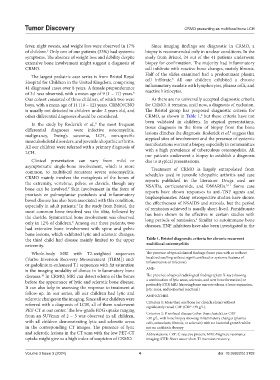
            other differential diagnoses should be considered.  CRMO, as shown in Table 1,  but these criteria have not
                                                                                       8
              In the  study by Roderick  et al.,  the most frequent   been validated in children. In atypical presentations,
                                          8
            differential diagnoses were infective osteomyelitis,   tissue diagnosis in the form of biopsy from the bone
                                                                                                   8
            malignancy, Ewing’s sarcoma, LCH, non-specific     lesions clinches the diagnosis. Roderick et al.  suggest that
            musculoskeletal disorders, and juvenile idiopathic arthritis.   atypical sites of involvement and the presence of systemic
            All our children were referred with a primary diagnosis of   manifestations warrant a biopsy, especially in communities
            LCH.                                               with a high prevalence of tuberculous osteomyelitis. All
                                                               our patients underwent a biopsy to establish a diagnosis
              Clinical presentation can vary from mild or      due to atypical presentations.
            asymptomatic  single-bone  involvement,  which  is  more   Treatment of CRMO is largely extrapolated from
            common, to multifocal recurrent severe osteomyelitis.   schedules used in juvenile idiopathic arthritis and case
            CRMO  mainly  involves  the  metaphysis  of  the  bones  of   reports published in the literature. Drugs used are
            the extremity, vertebrae, pelvis, or clavicle, though any   NSAIDs, corticosteroids, and DMARDs.  Some case
                                                                                                 5,11
            bone can be involved.  Skin involvement in the form of   reports have shown responses to anti-TNF agents and
                              9
            psoriasis or palmoplantar pustulosis and inflammatory   bisphosphonates. Many retrospective studies have shown
            bowel disease has also been associated with this condition,   the effectiveness of NSAIDS and steroids, but the period
            especially in adult patients.  In the study from Bristol, the   of remission achieved is usually short-lived. Pamidronate
                                  2
            most common bone involved was the tibia, followed by   has been shown to be effective in certain studies with
            the clavicle. Symmetrical bone involvement was observed   long periods of remission.  Similar to autoimmune bone
                                                                                    2
            only in 12% of children.  Among our three patients, two   diseases, TNF inhibitors have also been investigated in the
                                8
            had extensive bone involvement with spine and pelvic
            bone lesions, which exhibited lytic and sclerotic changes;
            the third child had disease mainly limited to the upper   Table 1. Bristol diagnostic criteria for chronic recurrent
            extremity.                                         multifocal osteomyelitis
              Whole-body  MRI with  T2-weighted sequences      The presence of typical clinical findings (bone pain with or without
            (Turbo  Inversion  Recovery  Measurement  [TIRM])  and/  localized swelling without significant local or systemic features of
            or gadolinium-enhanced T1 sequences with fat saturation   inflammation or infection)
            is the imaging modality of choice in inflammatory bone   AND
            diseases.  In CRMO, MRI can detect edema of the bones   The presence of typical radiological findings (plain X-ray [showing
                   10
            before the appearance of lytic and sclerotic bone disease.   a combination of lytic areas, sclerosis, and new bone formation] or
                                                               preferably STIR MRI [showing bone marrow edema ± bone expansion,
            It can also help in assessing the response to treatment at   lytic areas, and periosteal reaction])
            follow-up. In our series, all our children had lytic and   AND EITHER
            sclerotic changes in the imaging. Since all our children were
            referred with a diagnosis of LCH, all of them underwent   Criterion 1: More than one bone (or clavicle alone) without
                                                               significantly raised CRP (CRP <30 g/L).
            PET-CT at our center. The low-grade FDG uptake ranging
            from an SUVmax of 2 – 3 was observed in all children,   Criterion 2: If unifocal disease (other than clavicle), or CRP
                                                               >30 g/L, with bone biopsy showing inflammatory changes (plasma
            with all children demonstrating lytic and sclerotic areas   cells, osteoclasts, fibrosis, or sclerosis) with no bacterial growth whilst
            in the corresponding CT images. The presence of lytic   not on antibiotic therapy
            and sclerotic lesions in the CT scan with the low PET-CT   Abbreviations: CRP: C-reactive protein; MRI: Magnetic resonance
            uptake might give us a high index of suspicion of CRMO.  imaging; STIR: Short tau or short TI inversion recovery.


            Volume 3 Issue 3 (2024)                         4                                 doi: 10.36922/td.3102

