


Page 36 - AC-1-1
P. 36
Arts & Communication                             Reflections on the issues of the Journal of the History of Collections


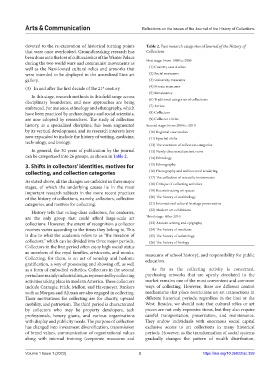
            devoted to the re-excavation of historical turning points   Table 2. Past research categories of Journal of the History of
            that were once overlooked. Groundbreaking research has   Collections
            been done as to the loss of cultural relics of the Winter Palace
            during the two world wars and communist movements as   First stage: From 1989 to 2000
            well as the Nazi-looted cultural relics and artworks that   (1) Country case studies
            were intended to be displayed in the unrealized Linz art   (2) Social museums
            gallery.                                            (3) University museums

            (3)  In and after the first decade of the 21  century  (4) Private museums
                                             st
                                                                (5) Renaissance
              In this stage, research methods in this field range across
            disciplinary boundaries, and new approaches are being   (6) Traditional categories of collections
            embraced. For instance, ethnology and ethnography, which   (7) Artists
            have been practiced by archaeologists and social scientists,   (8) Collectors
            are now adopted by researchers. The study of collection   (9) Collector circles
            history, as a specialized discipline, has been augmented   Second stage: From 2000 to 2010
            by its vertical development, and its research interests have   (10) Regional case studies
            now expanded to include the history of writing, medicine,   (11) Epochal shifts
            technology, and biology.
                                                                (12) The extension of collection categories
              In general, the 30 years of publication by the journal   (13) Newly discovered ancient ruins
            can be categorized into 26 groups, as shown in Table 2.  (14) Ethnology
            3. Shifts in collectors’ identities, motives for    (15) Ethnography
            collecting, and collection categories               (16) Photography and architectural rendering
                                                                (17) The collection of scientific instruments
            As stated above, all the changes are unfolded in three major   (18) Critique of collecting activities
            stages, of which the underlying causes lie in the most
            important research subjects in the more recent practices   (19) Reconstructing art spaces
            of the history of collections, namely, collectors, collection   (20) The history of ornithology
            categories, and motives for collecting.             (21) International cultural heritage preservation
              History tells that ruling-class collectors, for centuries,   (22) Modern art exhibitions
            are the only group that could afford large-scale art   Third stage: After 2010
            collections. However, the extent of recognition a collector   (23) Ancient writing and epigraphy
            receives varies according to the times they belong to. This   (24) The history of medicine
            is due to what the academia refers to as “the iteration of   (25) The history of technology
            collectors,” which can be divided into three major periods.   (26) The history of biology
            Collectors in the first period often enjoy high social status
            as members of the royal families, aristocrats, and monks.   museums of school history), and responsibility for public
            Collecting, for them, is an act of worship and hedonic   education.
            gratification, a way of possessing and showing off, as well
            as a form of embodied esthetics. Collectors in the second   As far as the collecting activity is concerned,
            period are mainly industrialists, as represented by collecting   purchasing artworks that are openly circulated in the
            activities taking place in modern America. These collectors   market remains one of the most convenient and common
            include Carnegie, Frick, Mellon, and Havemeyer. Bankers   ways of collecting. However, there are different control
            such as Morgan and Altman are also engaged in collecting.   mechanisms that place restrictions on art transactions in
            Their  motivations  for  collecting  are  for  charity,  upward   different historical periods, regardless in the East or the
            mobility, and patriotism. The third period is characterized   West. Besides, we should note that cultural relics or art
            by collectors who may be property developers, tech   pieces are not only expensive items, but they also require
            professionals,  luxury  giants,  and  various  organizations   careful transportation, preservation, and maintenance.
            with display and publicity needs. The purpose of collection   They  endow individuals with enormous social  capital
            has changed into investment diversification, transmission   exclusive  access  to  art  collections  in  many  historical
            of brand values, communication of organizational values   periods. However, as the transformation of social systems
            along with internal training (corporate museums and   gradually changes the pattern of wealth distribution,


            Volume 1 Issue 1 (2023)                         3                          https://doi.org/10.36922/ac.359

