


Page 110 - AC-1-2
P. 110
Arts & Communication                                            Music therapy and elderly people in home care


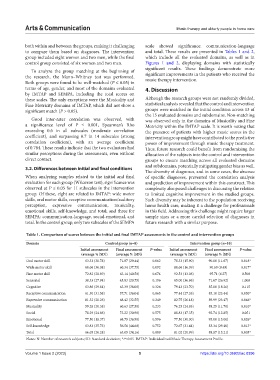
            both within and between the groups, making it challenging   scale  showed  significance:  communication-language
            to compare them based on diagnoses. The intervention   and total. These results are presented in Tables 1 and 2,
            group included eight women and two men, while the final   which include all the evaluated domains, as well as in
            control group consisted of six women and two men.  Figures  1  and  2, displaying domains with statistically
              To analyze the group matching at the beginning of   significant results. These findings demonstrate more
            the research, the Mann–Whitney test was performed.   significant improvements in the patients who received the
                                                               music therapy intervention.
            Both groups were found to be well-matched (P ≤ 0.05) in
            terms of age, gender, and most of the domains evaluated   4. Discussion
            by IMTAP and SEMPA, including the total scores on
            these scales. The only exceptions were the Musicality and   Although the research groups were not randomly divided,
            Fine Motricity domains of IMTAP, which did not show a   statistical analysis revealed that the control and intervention
            significant match (P > 0.05).                      groups were matched in the initial condition across 13 of
                                                               the 15 evaluated domains and subdomains. Non-matching
              Good inter-rater correlation was observed, with   was observed only in the domains of Musicality and Fine
            a significance level of  P  ≤ 0.001, Spearman’s Rho   Motricity within the IMTAP scale. It is worth noting that
            exceeding  0.6 in all subscales (moderate correlation   the presence of patients with higher music scores in the
            coefficient), and surpassing 0.7 in 14 subscales (strong   intervention group might have contributed to the predictive
            correlation coefficient), with an average coefficient   power of improvement through music therapy treatment.
            of 0.784. These results indicate that the two evaluators had   Thus, future research could benefit from randomizing the
            similar perceptions during the assessments, even without   allocation of the subjects into the control and intervention
            direct contact.                                    groups to ensure matching across all evaluated domains
                                                               and subdomains, potentially mitigating gender bias as well.
            3.2. Differences between initial and final conditions
                                                               The diversity of diagnoses, and in some cases, the absence
            When analyzing samples related to the initial and final   of specific diagnoses, prevented the correlation analysis
            evaluation for each group (Wilcoxon test), significance was   and prediction of improvement within this construct. This
            observed at P ≤ 0.05 for 11 subscales in the intervention   complexity also posed challenges in discussing the relation
            group. Of these, eight are related to IMTAP: wide motor   to limited cognitive improvement in the studied groups.
            skills, oral motor skills, receptive communication/auditory   Such diversity may be inherent to the population receiving
            perception,  expressive  communication,  musicality,  home health care, making it a challenge for professionals
            emotional skills, self-knowledge, and total; and three for   in this field. Addressing this challenge might require larger
            SEMPA: communication-language, social-emotional, and   sample sizes or a more careful selection of diagnoses in
            total. In the control group, only two subscales of the SEMPA   future research with a similar purpose.


            Table 1. Comparison of scores between the initial and final IMTAP assessments in the control and intervention groups
            Domain                            Control group (n=8)                 Intervention group (n=10)
                                   Initial assessment   Final assessment   P‑value  Initial assessment   Final assessment   P‑value
                                    (average % [SD])  (average % [SD])   (average % [SD])  (average % [SD])
            Oral motor skill         63.33 (30.78)  71.87 (29.44)  0.062   78.33 (15.90)  90.00 (11.67)  0.018*
            Wide motor skill         60.66 (36.08)  60.34 (37.75)  0.092   80.66 (16.09)  90.60 (9.49)  0.017*
            Fine motor skill         72.82 (28.89)  63.14 (40.50)  0.674   92.53 (13.06)  95.71 (6.27)  0.500
            Sensorial                38.33 (27.94)  45.83 (29.75)  0.196   65.00 (36.86)  71.67 (26.92)  1.000
            Cognitive                63.86 (29.84)  63.39 (38.08)  0.326   79.43 (23.70)  85.00 (18.26)  0.115
            Receptive communication  61.30 (31.58)  57.71 (36.04)  0.865   77.44 (27.26)  85.10 (23.44)  0.050*
            Expressive communication  81.32 (20.26)  68.42 (32.55)  0.249  82.75 (26.18)  89.99 (23.47)  0.046*
            Musicality               59.28 (20.38)  60.63 (27.58)  0.233   76.25 (24.93)  88.25 (11.78)  0.010*
            Social                   78.29 (24.86)  73.22 (30.98)  0.575   88.83 (17.35)  92.74 (12.85)  0.051
            Emotional                77.50 (18.37)  68.75 (36.98)  0.596   77.50 (30.00)  95.00 (15.00)  0.026*
            Self-knowledge           63.83 (35.73)  56.56 (44.60)  0.752   72.67 (31.44)  83.34 (29.40)  0.013*
            Total                    66.65 (26.28)  63.05 (34.16)  0.889   81.02 (20.99)  88.87 (15.21)  0.005*
            Notes: N: Number of research subjects; SD: Standard deviation; *P≤0.05. IMTAP: Individualized Music Therapy Assessment Profile.


            Volume 1 Issue 2 (2023)                         5                         https://doi.org/10.36922/ac.0396

