


Page 112 - AC-1-2
P. 112
Arts & Communication                                            Music therapy and elderly people in home care


                         A                                   B


                                             C


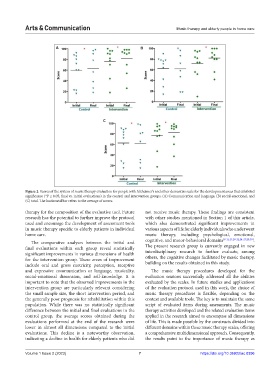
            Figure 2. Scores of the system of music therapy evaluation for people with Alzheimer’s and other dementias scale for the development areas that exhibited
            significance (*P ≤ 0.05, final vs. initial evaluations) in the control and intervention groups. (A) Communication and language, (B) social-emotional, and
            (C) total. The horizontal bar refers to the average of scores.

            therapy for the composition of the evaluative tool. Future   not receive music therapy. These findings are consistent
            research has the potential to further improve the protocol   with other studies mentioned in Section 1 of this article,
            used and encourage the development of assessment tools   which  also  demonstrated  significant  improvements  in
            in music therapy specific to elderly patients in individual   various aspects of life for elderly individuals who underwent
            home care.                                         music therapy, including psychological, emotional,
              The comparative  analyses  between  the initial  and   cognitive, and motor-behavioral domains [9-11,13,20-22,24-27,29,30] .
            final evaluations within each group reveal statistically   The present research group is currently engaged in new
            significant improvements in various dimensions of health   interdisciplinary research to further evaluate, among
            for  the  intervention  group.  These  areas  of  improvement   others, the cognitive changes facilitated by music therapy,
            include oral and gross motricity, perception, receptive   building on the results obtained in this study.
            and expressive communication or language, musicality,   The  music  therapy  procedures developed  for the
            social-emotional  dimension,  and  self-knowledge.  It  is   evaluation sessions successfully addressed all the abilities
            important to note that the observed improvements in the   evaluated by the scales. In future studies and applications
            intervention group are particularly relevant considering   of the evaluation protocol used in this work, the choice of
            the small sample size, the short intervention period, and   music therapy procedures is flexible, depending on the
            the generally poor prognosis for rehabilitation within this   context and available tools. The key is to maintain the same
            population. While there was no statistically significant   script of evaluated items during assessments. The music
            difference between the initial and final evaluations in the   therapy activities developed and the related evaluation items
            control group,  the average scores obtained during the   applied in the research aimed to encompass all dimensions
            evaluations performed at the end of the research were   of life. This is made possible by the constructs divided into
            lower in almost all dimensions compared to the initial   different domains within these music therapy scales, offering
            evaluations. This decline is  a  noteworthy  observation,   a comprehensive multidimensional approach. Consequently,
            indicating a decline in health for elderly patients who did   the results point to the importance of music therapy as


            Volume 1 Issue 2 (2023)                         7                         https://doi.org/10.36922/ac.0396

