


Page 24 - AC-1-2
P. 24
Arts & Communication                                                       A mean, the body. A mean body


            These tubes are used for flood prevention and for weighing   a  non-mutable  (solid)  grid  to  the  plaster  contained  in  a
            down swamped cars. Then, I take either a cotton or elastic   flexible fabric formwork, I tested the flexibility and the way
            cord, loop it around my body, and hang a sandbag from it.   the material would question that limit and fill in the spaces
            The sandbag needs to be equilibrated in the invagination   with its mass (Figure 4A). On the other hand, when I applied
            produced by its weight on the cord to avoid falling to the   adjustable grids — usually made of cotton cord  —  no
            ground.  The  material  of  the  sandbag  allows  it  to  deform   matter how adjustable they were, they would always end
            when placed over the cord, and as it hangs, it almost divides   up invaginating the material (Figure  4B), first in contact
            itself in two, leaving a thinner section hold in between.   with the fabric mold, and then when peeled, as a trace on
            Sometimes, only the fabric holds, and the sand accumulates   the plaster. Both processes left a scar — a gridded scar.
            in the two — almost — divisions below. Due to gravity, the   Moreover, even though one was more orthogonal, let’s say,
            sand wants to be closer to the ground, a reason I have come   because it did not deform, both were equally recognizable.
            to believe in and support. The cord, in a way, does the same   The grid was and is recognizable, and I like that. The result
            to my body as to the sandbag on its opposite side, where it   of these plaster pieces produced a very bodily feeling, both
            hangs. It tends to divide the section of my body where it is   in the hands and visually. They became sort of muscles—
            suspended, perhaps my arm or thigh. It invaginates my skin,   and cellular compositions—which eventually made me grid
            muscles, tissue, and cells — God knows if the atoms can feel   myself. The first try was just with tape, in an orthogonal way,
            it, too. I repeat this step and hang as many sandbags as I can   as I recognized my volume in space (Figure 5). Then, I hung
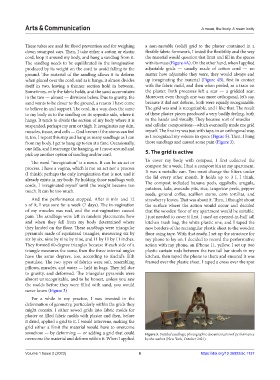
            from my body. I get to hang up to ten at a time. Occasionally,   those sandbags and caused some pain (Figure 3).
            one falls, and I rearrange the hanging, or I move around and
            pick up another option of sandbag and/or cord.     5. The grid is active
              The word “invagination” is a noun. It can be an act or   To  cover  my  body  with  compost,  I  first  collected  the
            process. I have a vagina, which is not an act nor a process   compost for a week. I had a compost bin in my apartment.
            (I think); perhaps the only invagination that is not, and it   It was a metallic can. You must change the filters under
            already exists in my body. By holding those sandbags with   the lid every other month. It holds up to 3 l, I think.
            cords, I invaginated myself until the weight became too   The compost included banana peels, eggshells, arugula,
            much. It can be too much.                          potatoes, kale, avocado pits, rice, tangerine peels, pepper
                                                               seeds, ground coffee, scallion stems, corn tortillas, and
              And  the  performance  stopped. After  8  min  and  12   strawberry leaves. That was about it. Then, I thought about
            s of it, I was sore for a week (7 days). The in-vagination   the surface where the action would occur and decided
            of my muscles was real, and the out-vagination caused   that the wooden floor of my apartment would be suitable.
            pain. The sandbags were left in random placements; how   I just needed to cover it first. I used an opened-in-half tall
            and when they fell from my body determined where   kitchen trash bag, the white plastic one, and I taped the
            they landed on the floor. These sandbags were triangular   new borders of the rectangular plastic sheet to the wooden
            pyramids made of equilateral triangles, measuring six by   floor using tape. With that ready, I set up the structure for
            six by six, nine by nine by nine, and 11 by 11 by 11 inches.   my phone to lay on. I decided to record the performative
            They formed 60-degree triangles because if each side of a   action with my phone, an iPhone 11, yellow. I set up two
            triangle measures the same, then the three internal angles   plastic curtain rods between the two tall bar stools in my
            have the same degrees, too, according to Euclid’s fifth   kitchen, then taped the phone to them and ensured it was
            postulate. The two types of fabrics were soft, resembling   framed over the plastic sheet. I taped a cross over the spot
            pillows, muscles, and water — held in bags. They fell due
            to gravity, and deformed. The triangular pyramids were
            almost unrecognizable, and to be honest, unless you saw
            the molds before they were filled with sand, you would
            never know (Figure 3)
              For a while in my practice, I was invested in the
            deformation of geometry, particularly within the grids they
            might contain. I  either sewed grids into fabric molds for
            plaster or filled fabric molds with plaster and then, before
            it dried, applied a grid to it. I would intervene, making the
            grid either a limit the material would have to overcome
            somehow — by deforming — or adding a grid that could   Figure 3. Untitled sandbags, photographic documentation of performance
            overcome the material and deform within it. When I applied   by the author (New York, October 2021).


            Volume 1 Issue 2 (2023)                         6                         https://doi.org/10.36922/ac.1137

