


Page 43 - AC-1-2
P. 43
Arts & Communication                                              Correlations between artworks and contacts


                                                               convenience. A  Pandas DataFrame is a structure that
                                                               contains two-dimensional data and its corresponding
                                                               labels . DataFrames are widely used in data science,
                                                                   [16]
                                                               machine learning, scientific computing, and many other
                                                               data-intensive fields. DataFrames share some similarities
                                                               with SQL  tables and spreadsheets, but in many cases,
                                                               DataFrames are faster, easier to use, and more powerful
                                                               than tables or spreadsheets because they are an integral
                                                               part of the Python ecosystem. Consequently, the ingestion
                                                               of the data provided us with the convenience of not having
                                                               to access the database and more freedom to transform the
                                                               data. We parsed 10,477 rows with entities and valid dates.
                                                               At this point, we also decided to create a DataFrame for
                                                               the artworks, which contained 35,886 rows.
                                                                 We decided to use two-dimensional grid visualization,
                                                               displayed as a grey and white  chart, where the colored
                                                               blocks represent a reference to an artwork or a personal
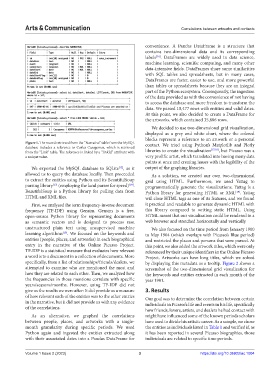
            Figure 1. The record retrieved from the “Narrative” table from the MySQL   contact. We tried using Python’s  Matplotlib and Plotly
            database includes a reference to Carles Casagemas, which is retrieved          [17,18]
            from the “Link” table. The reference is linked by a “linkId” attribute with   libraries to create the visualization  , but Picasso was a
            a unique value.                                    very prolific artist, which translated into having many data
                                                               points at once and creating issues with the legibility of the
              We exported the MySQL database to SQLite , as it   output of the graphing libraries.
                                                    [12]
            allowed us to query the database locally. Then proceeded   As a solution, we created our own two-dimensional
            to extract the entities using Python and its BeautifulSoup   grid  using  HTML.  Furthermore,  we  used  Yattag  to
                        [13]
                                                        [14]
            parsing library  (employing the lxml parser for speed) .   programmatically generate the visualizations. Yattag is a
            BeautifulSoup is a Python library for pulling data from   Python library for generating HTML or XML . Yattag
                                                                                                     [19]
            HTML and XML files.                                will close HTML tags as one of its features, and we found
              First, we analyzed the term frequency-inverse document   it practical and readable to generate dynamic HTML with
            frequency (TF-IDF) using Gensim. Gensim is a free,   this library compared to writing static HTML. Using
            open-source Python library for representing documents   HTML meant that our visualization could be rendered in a
            as semantic vectors and is designed to process raw,   web browser and stretched horizontally and vertically.
            unstructured plain text using unsupervised machine   We also focused on the time period from January 1900
            learning algorithms . We focused on the keywords and   to May 1904 (which overlaps with Picasso’s Blue period)
                            [15]
            entities (people, places, and artworks) in each biographical   and restricted the places and persons that were parsed. At
            entry  in  the narrative of  the  Online  Picasso  Project.   this point, we also added the artwork titles, which were only
            TF-IDF is a statistical measure that evaluates how relevant   referenced by their unique identifiers in the Online Picasso
            a word is to a document in a collection of documents. More   Project. Artworks can have long titles, which we solved
            specifically, from a list of relationships/friends/dealers, we   by displaying this metadata as a tooltip. Figure 2 shows a
            attempted to examine who are mentioned the most and   screenshot of the two-dimensional grid visualization for
            how they are related to each other. Then, we analyzed how   the keywords and entities extracted in each month of the
            the frequencies in those mentions correlate with specific   year 1901.
            years/seasons/months. However, using TF-IDF did not
            give us the results we were after: It did provide us a measure   3. Results
            of how relevant each of the entities was to the other entries   Our goal was to determine the correlation between certain
            in the narrative, but it did not provide us with any evidence   individuals in Picasso’s life and events in his life, specifically
            of the correlations.
                                                               how friends, lovers, artists, and dealers he had contact with
              As  an  alternative, we  graphed  the  correlations   might have influenced some of the known periods scholars
            between people, places, and artworks with a single-  have used to divide his artistic career. As a sample, we chose
            month  granularity  during specific  periods. We used   the entities as individuals listed in Table 1 and verified if, as
            Python again and ingested the entities extracted along   it has been reported in several Picasso biographies, those
            with their associated dates into a Pandas DataFrame for   individuals are related to specific time periods.


            Volume 1 Issue 2 (2023)                         3                         https://doi.org/10.36922/ac.1004

