


Page 63 - AC-1-2
P. 63
Arts & Communication                                                               Textile agency in art


               like a curtain, neither liquid nor solid, to be sure, but   sacred or multi-sensory metaphors. In 2007, Žaltauskaitė
               participating in both conditions. Pliable, tearable,   Grašienė  completed her  postgraduate studies  in Vilnius,
               stretchable. topological” .                     focusing on the history of Jacquard weaving and the new
                                   [6]
              Textiles, as a sensory metaphor for fibrous and networked   possibilities of its artistic expression, as revealed in her
            life, have also been proposed by other philosophers (Michel   series “Skin Paintings.” She became a “pioneer of computer
                                                                                                            [8]
            Foucault, Gilles Deleuze, Félix Guattari, Tim Ingold,   Jacquard in Lithuania and a virtuoso of this technique,”
            Geert Lovink) ,  who have  emphasized their  inherent   perfecting the specific method of digital image transfer to
                        4
            mediality. This quality allows us to detect the related or the   fabric. The complex weaving system requires mathematical
            indeterminate, the state of movement or change. Textiles   calculation and spatial network perception. In her words,
            have thus become a significant metaphorical concept.  Jacquard weaving is like building an image with threads.
                                                               Sometimes, it is necessary to use three-dimensional
              Žaltauskaitė Grašienė, as an artist, participates in this   images to perceive what is happening inside the fabric or
            “textile discourse.” Materiality is one of the fundamental   on its surface. The Jacquard machine allows technological
            driving forces behind her work. She admits: “I perceive   control over every thread of the warp and is considered a
            matter as an existing and imaginary state; it can be defined   pioneer of modern programming, a precursor of the digital
            as something more than a system of natural sciences. The   era that has evoked metaphors of the communication
            old Lithuanian dialect word “materiolas,” which refers   network. Perhaps this is why in Žaltauskaitė Grašienė’s
            to handmade fabric, aptly describes the textiles that   work, which is based on Jacquard weaving, the motifs
            encompass women’s life experiences and visions. Textiles   depicted appear as if in a matrix, linking the weaving
            are one of humanity’s oldest forms of material expression,   pattern to  the  language  of digital  codes.  Several  themes
            encoding a whole perception of the world”(personal   and cycles could be distinguished in her work, integrating
            communication).                                    into a connective metatextile narrative. These themes and
              It was textile artist Laima Oržekauskienė  who   cycles include issues of the body, identity, memory, and
                                                     5
            encouraged Žaltauskaitė Grašienėto study textiles at   becoming, bringing out various metaphors of fabric and
            the Vilnius Academy of Arts, Kaunas Faculty, where she   the agentic forces of material.
            created a distinctive school of conceptual textiles . This   2. Living matter
                                                    [7]
            school has fostered respect for the tradition of weaving as a
            spiritual value and an attitude toward textiles as a dynamic,   The theme of corporeality, exploring the relationship
            changing medium (attracting and involving other media).   between skin and cloth, body and clothing, organic and
            The threads of personal experiences and subtle observations   inorganic fabric, as well as living and non-living matter,
            of everyday life in the work of its representatives are   has captivated the interest of many contemporary artists
            woven into a broad fabric of art, cultural history, or   in various aspects. In her series “Generations” (2005) and
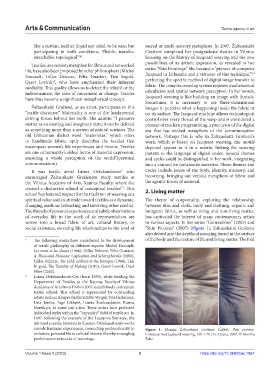
            social existence, elevating life relationships to the level of   “Skin Pictures” (2007) (Figure  1), Žaltauskaitė Grašienė
                                                               also delved into the depths of meaning found in the surface
            4    The following works have contributed to the development   of the body and the texture of life and living matter. The fold
               of textile philosophy in different aspects: Michel Foucault,
               Les mots et les choses (1966); Gilles Deleuze, Felix Guattari,
               A Thousand Plateaus: Capitalism and Schizophrenia (1980),
               Gilles Deleuze, The Fold: Leibniz & the Baroque (1988), Tim
               In gold, The Textility of Making (2010), Geert Lovink, Dark
               Fiber (2002).
            5    Laima Oržekauskienė-Ore (born 1959), while heading the
               Department of Textiles at the Kaunas Facultyof Vilnius
               Academy of Arts from 1996 to 2007, established a conceptual
               textile school. This school is represented by outstanding
               artists such as Almyra Bartkevičiūtė-Weigel, Vita Gelūnienė,
               Lina Jonikė, Inga Likšaitė, Loreta Švaikauskienė, Rasma
               Noreikytė, to name just a few. These artists have perfected
               individual styles within the “expanded” field of textile art. In
               1997, following the example of the Lausanne Biennale, she
               initiated a textile biennale in Kaunas. Oržekauskienė’s works
               encode feminine experiences, connecting postmodernity to   Figure  1. Monika Žaltauskaitė Grašienė (Žaltė),  Skin  pictures.
               archaism, personal life to cultural history, thereby entangling   Computerized Jacquard weaving, 150 × 70 cm, 5 parts, 2007. © Monika
               performative networks of meanings.              Žaltė.


            Volume 1 Issue 2 (2023)                         3                         https://doi.org/10.36922/ac.1867

