


Page 66 - AC-1-2
P. 66
Arts & Communication                                                               Textile agency in art


            a computer loom, taking on an abstract form, eventually   Mary and was stunned to see her smile in the photo,
            transformed the impression into a monumental curtain,   which inspired her to create a series of tapestries.
            promising a mysterious unfolding of meanings.      Surprisingly, the smile that she captured seemed to
              The tapestry series “St. Mary’s Rugs” and “Smiling”   have slipped off the surface of the burnt sculpture in
            are also artworks woven from visual quotations. The   the chapel due to the effects of the environment and
            idea for the first cycle was sparked by an impression   was only captured in that artwork.
            of the Virgin standing on the right side of the altar   Exploring folds, textile metaphors also arise from
            at the Vytautas Magnus Church in Kaunas. The artist   unexpected semantic connotations. This is how the series
            describes her initial creative impulse as follows: “I took   “May It Unfold Nicely” (the literal meaning of a Lithuanian
            a closer look at the small sculpture, about 40 cm high,   saying “Geros kloties,” used to wish someone good luck)
            with very skillfully carved drapery, which seemed to   was formed, conceptualizing the enigmatic links between
            move for a moment as I looked at it. That’s what led   the meanings of laying and unfolding, the shroud and
            me to the series of works” (personal communication).   good luck. This encouraged the creation of various visual
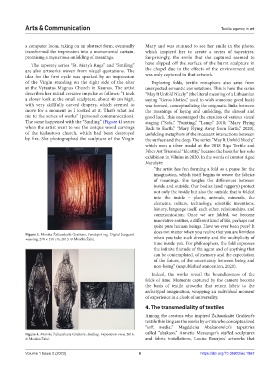
            The same happened with the “Smiling” (Figure 4) series   staging  (“Sofa,”  “Painting,”  “Lamp,”  2018;  “Mary  Flying
            when the artist went to see the unique wood carvings   Back to Earth,” “Mary Flying Away from Earth,” 2020),
            of the Kulautuva church, which had been destroyed   unfolding metaphors of the incessant interactions between
            by fire. She photographed the sculpture of the Virgin   the surface and the deep. The series “May It Unfold Nicely,”
                                                               which  won  a silver  medal  at  the 2018  Riga  Textile  and
                                                               Fiber Art Triennial “Identity,” became the basis for her solo
                                                               exhibition in Vilnius in 2020. In the words of curator Agnė
                                                               Narušytė:
                                                                  “the artist has fun forming a fold as a pause for the
                                                                  imagination, which itself begins to weave the fabrics
                                                                  of meanings. She tangles the differences between
                                                                  inside and outside. Our bodies (and raggery) protect
                                                                  not only the inside but also the outside that is folded
                                                                  into  the  inside  –  plants,  animals,  minerals,  the
                                                                  elements, culture, technology, scientific inventions,
                                                                  history, language itself, each other, relationships, and
                                                                  communication.  Once we  are  folded, we  become
                                                                  innovative entities, a different kind of life, perhaps not
                                                                  quite pure human beings. Have we ever been pure? It
                                                                  does not matter when you realize that you are limitless
            Figure 3. Monika Žaltauskaitė Grašienė, Penelope’s rag. Digital Jacquard
            weaving, 278 × 210 cm, 2013. © Monika Žaltė.          when you take such diversity and the multiplicity of
                                                                  time inside you. For philosophers, the fold expresses
                                                                  the infinite finitude of the agent and of anything that
                                                                  can be contemplated, of memory and the expectation
                                                                  of the future, of the uncertainty between being and
                                                                  non-being” (unpublished annotation, 2020).
                                                                 Indeed, the works reveal the boundlessness of the
                                                               folds of time. Moments captured by the camera become
                                                               the  basis  of  textile  artworks  that  return  fabric  to  the
                                                               archetypal imagination, wrapping an individual moment
                                                               of experience in a cloak of universality.

                                                               4. The transmediality of textiles
                                                               Among the creators who inspired Žaltauskaitė Grašienė’s
                                                               textile thinking are the works by artists who conceptualized
                                                               “soft media:” Magdalena Abakanowicz’s tapestries
            Figure 4. Monika Žaltauskaitė Grašienė, Smiling. Exposition view, 2016.   called “abakans,” Annette Messanger’s stuffed sculptures
            © Monika Žaltė.                                    and fabric installations, Louise Bourjois’ artworks that


            Volume 1 Issue 2 (2023)                         6                         https://doi.org/10.36922/ac.1867

