


Page 69 - AC-1-2
P. 69
Arts & Communication                                                               Textile agency in art


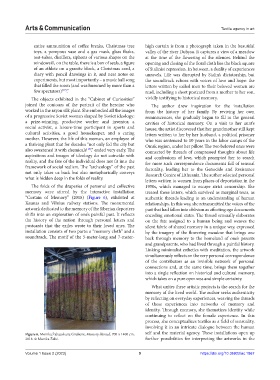
               entire ammunition of coffee breaks, Christmas tree   high curtain is from a photograph taken in the beautiful
               toys, a pompous vase and a gas mask, glass flasks,   valley of the river Dubysa. It captures a view of a meadow
               test-tubes, distillers, siphons of various shapes on the   at the time of the flowering of the silences. Behind the
               windowsill, on the table, there is a box of seals, a figure   opening and closing of the floral cloth lies the black square
               of an athlete on a granite block, a Christmas card, a   of Stalinist repression. In between, a duality of experiences
               diary with pencil drawings  in it, and  neat notes on   unravels.  Life  was  disrupted  by  Stalin’s  dictatorship,  but
               experiments, but most importantly – a music hall song   the soundtrack echoes with voices of love and hope: the
               that filled the room (and was hummed by more than a   letters written by exiled men to their beloved women are
               few spectators) .”                              read, including a short postcard from a mother to her son,
                           [17]
              The objects exhibited in the “Cabinet of Curiosities”   vividly testifying to historical memory.
            joined the contours of the portrait of the heroine who   The  author drew inspiration for  the  installation
            worked in the rayon silk plant. She embodied all the images   from the history of her family. By reviving her own
            of a progressive Soviet woman shaped by Soviet ideology:   reminiscences, she gradually began to fill in the general
            a prize-winning, productive worker and inventor, a   cavities of historical memory. On a visit to her  aunt’s
            social activist, a leisure-time participant in sports and   house, the artist discovered that her grandmother still kept
            cultural activities, a good housekeeper, and a caring   letters written to her by her husband, a political prisoner
            mother. However, the life of this woman, an employee of   who was sentenced to 10 years in the labor camps of the
            a thriving plant that for decades “not only fed the city but   Omsk region, under her pillow. The two beloved ones were
            also sweetened it with chemicals ,” ended very early. The   connected by threads of compressed thoughts about life
                                      [18]
            aspirations and images of ideology do not coincide with   and confessions of love, which prompted her to search
            reality, and the fate of the individual does not fit into the   for more such correspondence documents full of sensual
            framework of social realism. The “archeology” of the past   factuality, leading her to the Genocide and Resistance
            not only takes us back but also metaphorically conveys   Research Centre of Lithuania. The author selected personal
            what is hidden deep in the folds of reality.       letters written to women from places of deportation in the

              The folds of the draperies of personal and collective   1950s, which managed to escape strict censorship. She
            memory were stirred by the interactive installation   treated these letters, which survived as marginal texts, as
            “Curtain of Memory” (2018)  (Figure  6), exhibited at   authentic  threads leading to an understanding of human
            Kaunas and Vilnius railway stations. The monumental   relationships. In this way, she retransmitted the voices of the
            artwork dedicated to the memory of the Siberian deportees   past that had fallen into oblivion as affecting ego documents
            shifts into an exploration of one’s painful past. It reflects   encoding emotional states. The thread sensually elaborates
            the history of the nation through personal letters and   on  the  fate assigned to  a  human  being  and  weaves  the
            postcards that the exiles wrote to their loved ones. The   silent fabric of shared memory in a unique way, expressed
            installation consists of two parts: a “memory cloth” and a   by the imagery of the flowering meadow that brings one
            soundtrack. The motif of the 5-meter-long and 7-meter-  back through  memory to  the  homeland  of one’s  parents
                                                               and grandparents, who had lived through a painful history.
                                                               Linking minimalist esthetics with meditation, the artwork
                                                               simultaneously reflects on the very personal correspondence
                                                               of the contributors as an invisible network of personal
                                                               connections and, at the same time, brings them together
                                                               into a single reflection on historical and cultural memory,
                                                               which takes on a pure openness and simple certainty.
                                                                 What unites these artistic projects is the search for the
                                                               memory of the lived world. The author seeks authenticity
                                                               by reflecting on everyday experiences, weaving the threads
                                                               of these experiences into networks of memory and
                                                               identity. Through memory, she thematizes identity while
                                                               continuing to reflect on the female experience. In this
                                                               process, she conceptualizes textiles as a field of sensuality,
                                                               involving it in an intricate dialogue between the human
            Figure 6. Monika Žaltauskaitė Grašienė, Memory Shroud, 700 × 1400 cm,   self and the material agency. These installations open up
            2018. © Monika Žaltė.                              further possibilities for interpreting the artworks in the


            Volume 1 Issue 2 (2023)                         9                         https://doi.org/10.36922/ac.1867

