


Page 70 - AC-1-2
P. 70
Arts & Communication                                                               Textile agency in art


            context of “material turn,” addressing the social life of
            things, their narrative, and conversational capacities by
            extending narratives to other entities and intertwining
            humans and nonhumans.
            6. The horizons of being

            Textiles, as a medium of sensory thought, become a
            conceptual  tool  that  encourages  a  deeper  exploration  of
            the  interconnections between  material  agents  and the
            surrounding environment. Monika Žaltė’s recent work
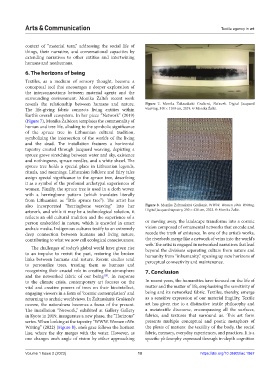
            reveals the relationship between humans and nature.   Figure  7. Monika Žaltauskaitė Grašienė,  Network. Digital Jacquard
            The life-giving fabric connects living entities within   weaving, 140 × 1100 cm, 2019. © Monika Žaltė.
            Earth’s overall ecosystem. In her piece “Network” (2019)
            (Figure 7), Monika Žaltėcon templates the commonality of
            human and tree life, alluding to the symbolic significance
            of the spruce tree in Lithuanian cultural tradition,
            symbolizing the intersection of the worlds of the living
            and the dead. The installation features  a horizontal
            tapestry created through Jacquard weaving,  depicting a
            spruce grove stretching between water and sky, existence
            and nothingness, spruce needles, and a white shawl. The
            spruce  tree  holds  a special  place  in  Lithuanian  legends,
            rituals, and meanings. Lithuanian folklore and fairy tales
            assign special significance to the spruce tree, describing
            it as a symbol of the profound archetypal experiences of
            women. Finally, the spruce tree is used in a cloth woven
            with a herringbone pattern (which translates literally
            from Lithuanian as “little spruce tree”). The artist has
            also incorporated “herringbone weaving” into her   Figure 8. Monika Žaltauskaitė Grašienė, WWW. Women oWn Writing.
            artwork, and while it may be a technological solution, it   Digital Jacquard tapestry, 250 × 420 cm, 2022. © Monika Žaltė.
            reflects an old cultural tradition and the experience of a
            person embedded in nature, which is encoded in smart   or moving away, the landscape transforms into a cosmic
            archaic media. Indigenous cultures testify to an extremely   vision composed of ornamental networks that encode and
            deep  connection between  humans and  living  nature,   recode the truth of existence. In one of the artist’s works,
            contributing to what we now call ecological consciousness.  the riverbeds merge like a network of veins into the world’s
                                                               web. The artist is engaged in networked narratives that lead
              The challenges of today’s global world have given rise   beyond the divisions separating culture from nature and
            to an impulse to revisit the past, restoring the broken   humanity from “inhumanity,” opening up new horizons of
            links between humans and nature. Recent studies tend   perceptual connectivity and maintenance.
            to personalize trees, treating them as humans and
            recognizing their crucial role in creating the atmosphere   7. Conclusion
            and the networked fabric of our being . In response
                                             [19]
            to the climate crisis, contemporary art focuses on the   In recent years, the humanities have focused on the life of
            vital and creative powers of trees on their bio-intellect,   matter and the matter of life, emphasizing the sensitivity of
            engaging viewers in a form of “cosmic contemplation” and   being and its networked fabric. Textiles, thereby, emerge
            returning to archaic worldviews. In Žaltauskaitė Grašienė’s   as a sensitive expression of our material fragility. Textile
            oeuvre, the naturalness becomes a focus of the present.   art has given rise to a distinctive textile philosophy and
            The installation  “Network,”  exhibited  at Gallery Gallery   a metatextile discourse, encompassing all the surfaces,
            in Kyoto in 2019, inaugurates a new phase, the “Horizons”   fabrics, and textures that surround us. This art form
            series. When looking at the tapestry “WWW. Women oWn   presents multiple conceptual and poetic metaphors of
            Writing” (2022) (Figure 8), one’s gaze follows the horizon   the pleats of matters: the textility of the body, the social
            line, where the sky merges with the water. However, as   fabric, memory, everyday experiences, and practices. It is a
            one changes one’s angle of vision by either approaching   specific philosophy expressed through in-depth cognition


            Volume 1 Issue 2 (2023)                         10                        https://doi.org/10.36922/ac.1867

