


Page 75 - AC-1-2
P. 75
Arts & Communication                                        Creativity and cyanotype: Camera-less photography


            3.  How to make cyanotype artwork                  artists  who  have used this  technique  to develop art
            4.  Materials needed to perform the technique      projects. The technical and conceptual possibilities that
            5.  Exploration of printing surfaces               can be achieved using this medium were discussed and the
            6.  The film negatives                             questions related to photography were answered during
            7.  Intensification and toning                     the workshop. Subsequently, instructions on creating
            8.  Preparation of chemicals                       cyanotype artwork were provided.
            9.  Conservation and storage                         The participants received training on the chemicals

              Based on this curriculum, a course plan was offered   used in the process, and some cyanotype art projects were
            to the school administration and headmasters from three   analyzed. There was an open dialog on how these works
            different art schools. The workshop was also offered in   were created, and the themes and concepts that these
            two communities located on the outskirts of the city of   works seek to convey. Once the presentation was over,
            Aguascalientes, Mexico.                            there was a discussion and a practical demonstration of
                                                               how to develop a cyanotype that had been left exposed in
            3. Cyanotype in practice – workshop                the sunlight.

            The workshop proposal was accepted by the three art   The practical demonstration was effective as it caught
            schools: Taller Casa Comuna and LaBArte 344, both   the attention of the students who were surprised to see how
            located in old buildings within the downtown area in   the exposed image emerged when it was washed under
            the city of Aguascalientes, and Universidad de las Artes,   running water, and some of them even described this
            located in the old railway complex in the same city. The   process as “something magical.”
            sessions were conducted in accordance with the previously   The second session began with the application of
            presented schedule.  Despite being bound by  different   chemicals to bond paper so that the participants learned
            spatial qualities in art teaching, these three schools were   about  the  process  of  emulsifying  surfaces.  This  allowed
            able to achieve all the learning objectives, by making small   them to observe the differences between working with
            adaptations and adjustments to the curriculum.     watercolor  paper  and recycled  paper.  Later, transparent
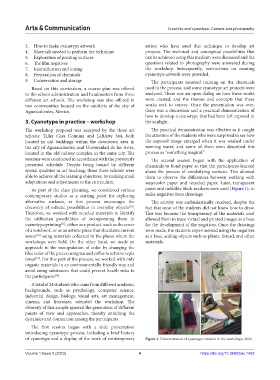
              As part of the class planning, we considered various   paper and indelible black markers were used (Figure 1), to
            contemporary studies as a starting point for exploring   make negatives from drawings.
            alternative surfaces,  as this  process  encourages  the   The activity was enthusiastically received, despite the
            discovery of esthetic possibilities in everyday objects .   fact that most of the students did not know how to draw.
                                                        [10]
            Therefore, we worked with recycled materials to identify   This was because the transparency of the materials used
            the utilitarian possibilities of incorporating them in   allowed them to trace virtual and printed images as a base
                           [11]
            cyanotype printing , either as a product, such as the cover   for the development of the negatives. Once the drawings
            of a notebook, or as an artistic piece that elucidates current   were made, the students experimented using the negatives
            issues  using materials collected in the places where the   as a base, adding objects such as plants, thread, and other
                [12]
            workshops were held. On the other hand, we made an   materials.
            approach  to  the  manipulation of  color  by  changing  the
            blue color of the pieces using tea and coffee to achieve sepia
            tones . For this part of the process, we worked with only
                [13]
            organic materials in an environmentally friendly way and
            avoid using substances that could present health risks to
            the participants .
                        [14]
              A total of 24 students who came from different academic
            backgrounds, such as psychology, computer science,
            industrial design, biology, visual arts, art management,
            cinema, and literature, attended the workshop. The
            diversity of this sample spurred the generation of different
            points of view and approaches, thereby enriching the
            dynamics and connection among the participants.
              The first session began with a slide presentation
            introducing cyanotype process, including a brief history
            of cyanotype and a display of the work of contemporary   Figure 1. Demonstration of cyanotype creation in the workshops, 2022.


            Volume 1 Issue 2 (2023)                         4                         https://doi.org/10.36922/ac.1453

