


Page 86 - AC-1-2
P. 86
Arts & Communication                                                    Digital restoration with generative AI


            artwork. The resultant image conspicuously underscored   crucial role of human oversight in ensuring accuracy and
            the constraints tied to the nuances of human craftsmanship   authenticity.
            and interpretation.                                  Venturing further, the study experimented with an
              In the ensuing phase, AI mechanisms were employed,   integrated approach, harmonizing manual restoration
            leveraging the capabilities of Stable Diffusion. The   techniques  with  AI  functionalities  (Figure  5).  A  precise
            parameters set for this endeavor included a prompt strength   descriptive prompt was input into the AI model, elaborating
            of 50%, a guidance scale of 7.5, and a commencement of 25   on various facets and elements intrinsic to the painting. This
            inference steps (Figure 4). Intriguingly, the AI exhibited   was complemented by a host of technical determinants,
            a propensity  for misinterpretation:  rather  than faithfully   including seed values and specified dimensions. In this
            restoring the damaged sections, the AI reconstructed   phase, the inpainting function was employed judiciously
            them as entirely distinct celestial entities. Such an outcome   to rectify minor imperfections. The parameters deployed
            underscores the challenges AI encounters in deciphering   were comprehensive: encompassing a detailed description
            and preserving the inherent artistic intent, echoing   of the painting’s elements, a designated seed, explicit
            the insights propounded by Yu  et al. (2021) about the   dimensions, and other technicalities such as inference
                                                               steps and the guidance scale. Notably, the amalgamation
                                                               of manual expertise with AI acumen culminated in an
                                                               outcome  that  bore a  close  resemblance to  the  original
                                                               artwork.  However,  this  outcome  was  not  without  minor
                                                               inconsistencies, especially in terms of color fidelity and the
                                                               visibility of certain superficial imperfections.

                                                                 An exhaustive exploration into the efficacy of
                                                               inpainting was undertaken, marked by multiple iterations
                                                               to determine optimal outcomes (Figure  6). Following
                                                               the initial two rounds, a conspicuous reduction in visible
                                                               imperfections  was observed.  However, this  came  at
                                                               the detriment of the integrity of color representation,
                                                               especially affecting the nuanced details of Achilles’ hands
                                                               and  facial  contours.  Proceeding  to the  fifth round,  an
                                                               almost complete obliteration of scratches was achieved,
                                                               yet this was accompanied by an altered color gradient. By
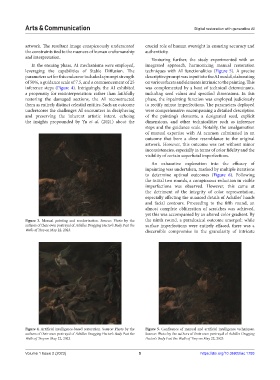
            Figure  3.  Manual painting and recolorization. Source: Photo by the   the  ninth  round,  a  paradoxical  outcome  emerged:  while
            authors of their own portrayal of Achilles Dragging Hector’s Body Past the   surface imperfections were entirely effaced, there was a
            Walls of Troy on May 22, 2023.                     discernible compromise in the granularity of intricate


            Figure 4. Artificial intelligence-based restoration. Source: Photo by the   Figure  5.  Confluence of manual and artificial intelligence techniques.
            authors of their own portrayal of Achilles Dragging Hector’s Body Past the   Source: Photo by the authors of their own portrayal of Achilles Dragging
            Walls of Troy on May 22, 2023.                     Hector’s Body Past the Walls of Troy on May 22, 2023.


            Volume 1 Issue 2 (2023)                         5                         https://doi.org/10.36922/ac.1793

