


Page 105 - AC-2-2
P. 105
Arts & Communication                                                Visual decoding: Buddhist image houses


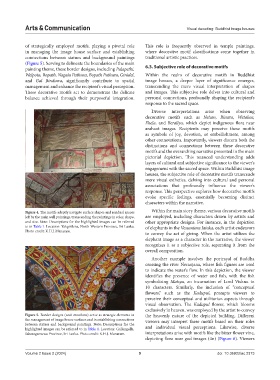
            of strategically employed motifs, playing a pivotal role   This role is frequently observed in temple paintings,
            in managing the image house surface and establishing   where decorative motif classifications come together in
            connections  between  statues  and  background  paintings   traditional artistic practices.
            (Figure 5). Serving to delineate the boundaries of the main
            painting theme, these border designs, including Palapethi,   6.3. Subjective role of decorative motifs
            Welpota, Bopath, Nagala Pathura, Bopath Pathura, Ginidel,   Within the realm of decorative  motifs in Buddhist
            and  Gal Binduwa, significantly contribute to spatial   image  houses,  a  deeper  layer  of  significance  emerges,
            management and enhance the recipient’s visual perception.   transcending the  mere  visual  interpretation of  shapes
            These  decorative  motifs  act  to  demonstrate  the  delicate   and images. This subjective role delves into cultural and
            balance achieved through their purposeful integration.   personal connections, profoundly shaping the recipient’s
                                                               response to the sacred space.
                                                                 Diverse  interpretations  arise  when  observing
                                                               decorative motifs such as  Nelum, Binara, Wetakae,
                                                               Ehela,  and Beraliya, which depict indigenous flora near
                                                               arahant images. Recipients  may perceive these motifs
                                                               as symbols of joy, devotion, or embellishment, among
                                                               other connotations. Importantly, viewers discern both the
                                                               distinctions  and  connections  between  these  decorative
                                                               motifs and the overarching narrative presented in the main
                                                               pictorial depiction. This nuanced understanding adds
                                                               layers of cultural and subjective significance to the viewer’s
                                                               engagement with the sacred space. Within Buddhist image
                                                               houses, the subjective role of decorative motifs transcends
                                                               mere visual esthetics, delving into cultural and personal
                                                               associations  that  profoundly  influence  the  viewer’s
                                                               response. This perspective explores how decorative motifs
                                                               evoke specific feelings, essentially becoming distinct
                                                               characters within the narrative.

            Figure 4. The motifs adeptly navigate surface shapes and residual spaces   Within the main story theme, various decorative motifs
            left by the main wall paintings, transcending the paintings in color, shape,   are employed, including characters drawn by artists and
            and size. Note: Descriptions for the highlighted images can be referred   other appropriate designs. For instance, in the depiction
            to in Table 1. Location: Yakgirilena, North Western Province, Sri Lanka.   of elephants in the Vessantara Jataka, each artist endeavors
            Photo credit: K.H.J. Manaram.
                                                               to convey the act of giving. When the artist utilizes the
                                                               elephant image as a character in the narrative, the viewer
                                                               recognizes it as a subjective role, separating it from the
                                                               overall composition.
                                                                 Another example involves the portrayal of Buddha
                                                               crossing the river Neranjana, where fish figures are used
                                                               to indicate the water’s flow. In this depiction, the viewer
                                                               identifies the presence of water and fish, with the fish
                                                               symbolizing  Matsya, an incarnation of Lord Vishnu in
                                                               10 characters. Similarly, the inclusion of “conceptual
                                                               flowers,”  such  as  the  Kadupul,  prompts  viewers  to
                                                               perceive their conceptual and utilitarian aspects through
                                                               visual observation. The  Kadupul flower, which blooms
                                                               exclusively in heaven, was employed by the artist to convey
            Figure 5. Border designs (wati mosthara) serve as strategic elements in   the heavenly nature of the depicted building. Different
            the management of image house surfaces and in establishing connections   viewers may interpret these motifs based on their roles
            between statues and background paintings. Note: Descriptions for the
            highlighted images can be referred to in Table 1. Location: Gallengolla,   and individual visual perceptions. Likewise, diverse
            Sabaragamuwa Province, Sri Lanka. Photo credit: K.H.J. Manaram.  interpretations arise with motifs like the bitter flower vine,
                                                               depicting flora near god images (4n) (Figure 6). Viewers


            Volume 2 Issue 2 (2024)                         9                                doi: 10.36922/ac.2373

