


Page 16 - AC-2-2
P. 16
Arts & Communication                                           1980s: A turning point in the Chinese art market


                                                               a result of reform and opening up, although historical
                                                               challenges that could not be entirely reversed. However,
                                                               the reforms significantly revitalized the art market. The folk
                                                               art market and the state-owned antique stores operated in
                                                               tandem during this era. Moreover, the collective ownership
                                                               and Sino-foreign joint venture entities explored different
                                                               management theories and practices to accomplish various
                                                               goals. Chinese businesses, represented by the Beijing Hotel
                                                               and Jingfeng Hotel, established a Chinese art collection
                                                               system in response to the art museum’s lack of funding and
                                                               challenges in acquisition, preserving innumerable priceless
                                                               artworks in the process. In the broader market context,
                                                               price fluctuations and shifts in the status of Chinese artists
                                                               have emerged as key elements of the 1980s art market.
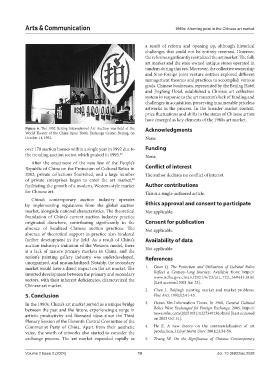
            Figure  6. The 1992 Beijing International Art Auction was held at the   Acknowledgments
            World Theater of the China-Japan Youth Exchange Center, Beijing, on
            October 11, 1992.                                  None.

            over 170 auction houses within a single year in 1992 due to   Funding
            the trending auction sector, which peaked in 1993. 23  None.
              After the enactment of the new law of the People’s
            Republic of China on the Protection of Cultural Relics in   Conflict of interest
            2002, private collections flourished, and a large number   The author declares no conflict of interest.
            of private enterprises began to enter the art market,
                                                         24
            facilitating the growth of a modern, Western-style market   Author contributions
            for Chinese art.                                   This is a single-authored article.
              China’s contemporary auction industry operates
            by implementing regulations from the global auction   Ethics approval and consent to participate
            market, alongside national characteristics. The theoretical   Not applicable.
            foundation of China’s current auction industry practice
            originated elsewhere, contributing significantly to the   Consent for publication
            absence of localized Chinese auction practices. The   Not applicable.
            absence of theoretical support in practice also hindered
            further development in the field. As a result of China’s   Availability of data
            auction industry’s imitation of the Western model, there
            is a lack of mature primary markets in China, and the   Not applicable.
            nation’s  painting  gallery  industry  was  underdeveloped,   References
            unorganized, and unstandardized. Notably, the secondary
            market would have a direct impact on the art market. The   1.   Guan Q.  The  Protection  and Utilization  of  Cultural  Relics
            inverted development between the primary and secondary   Reflect a Century-Long Journey. Available from: https://
                                                                  www.ncha.gov.cn/art/2021/6/23/art_722_169443.html
            sectors, with their inherent deficiencies, characterized the   [Last accessed 2021 Jun 23].
            Chinese art market.
                                                               2.   Chen L. Beijing’s painting market and market problems.
            5. Conclusion                                         Fine Arts. 1990;12:41-45.
            In the 1980s, China’s art market served as a unique bridge   3.   Ocean Net-Information Times.  In  1960,  General  Cultural
            between the past and the future, experiencing a surge in   Relics Were Exchanged for Foreign Exchange; 2005. https://
            artistic productivity and liberated ideas since the Third   news.sohu.com/20051031/n227349136.shtml [Last accessed
                                                                  on 2005 Oct 31].
            Plenary Session of the Eleventh Central Committee of the
            Communist Party of China. Apart from their aesthetic   4.   He Z. A  new theory on the commercialization of art
            value, the worth of artworks also started to consider the   production. J Linyi Norm Univ. 2001;23:54-56.
            exchange process. The art market expanded rapidly as   5.   Zhang W. On the Significance of Chinese Contemporary


            Volume 2 Issue 2 (2024)                         10                               doi: 10.36922/ac.2028

