


Page 22 - AC-2-2
P. 22
Arts & Communication                                         A perspective on art-based and academic research


            in non-written forms. Consequently, these two modes of
            reflection can therefore be seen as contrasting approaches
            to thinking.
              A fresh example of art-based research on theater is
            Lisa Charlotte Baudouin Lie’s Ph.D. project from KHIO in
            2023. Through several stage performances, she investigated
            techniques and insights from the intersection between
            magical and artistic practices and how to evoke collective
            forms of thought that have since inhabited the work. Her
            advantage as a researcher is that she is a performer, writer,
            and director. In other words, she is both a performing artist
            and a creative artist. Performing artists are not considered
            creative artists in copyright laws (as mentioned, in what
            way a performing artist is creative or not can truly be
            debated, but that discussion belongs to a different study).
            The main difference is that as a writer and director, she
            could refer to art outside herself – in addition to her
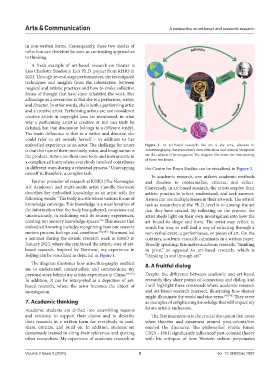
            embodied experience as an actor. The challenge for actors   Figure  1.  In art-based  research,  the  art is  the  core,  whereas  in
            is that their use of their own body, voice, and imagination is   autoethnography, the researcher’s own reflections and cultural viewpoint
            the product. Actors are their own tools and instruments in   are the subjects of investigation. The diagram illustrates the intertwining
            a complicated loom where everybody involved contributes   of these two lenses.
                                               4
            in different ways during a rehearsal process.  Unwrapping   the Centre for Ibsen Studies can be visualized in Figure 2.
            oneself is, therefore, a complex task.
                                                                 In academic research, one utilizes academic methods
              Former protector of research at KHIO (The Norwegian   and theories to contextualize, criticize, and reflect.
            Art Academy) and multi-media artist Camille Norment   Conversely, in art-based research, the artists employ their
            describes her embodied knowledge as an artist with the   artistic practice to reflect, understand, and seek answers.
            following words: “The body is a site where various forms of   Artists can use multiple lenses in their artwork. The artists’
            knowledge converge. This knowledge is a manifestation of   task as researchers at the Ph.D. level is to unwrap the art
            the information that the body has gathered, conscious and   that  they  have  created.  By  reflecting  on  the  process,  the
            unconsciously, in reckoning with its sensory experiences,   artist sheds light on their own investigation into how the
            creating our sensory knowledge spaces.”  This means that   art found its shape and form. The artist may reflect in
                                            26
            embodied knowing includes recognizing how our sensory   words but may as well find a way of reflecting through a
            motors process feelings and emotions. 27(p145)  Norment led   non-verbal event, a performance, or pieces of art. On the
            a seminar during the artistic research week at KHIO in   contrary, academic research culminates in a written paper.
            January 2023, where she reinforced the artistic core of art-  Broadly speaking, this makes academic research, “thinking
            based research. Inspired by Norment, my experience in   in print,” as opposed to art-based research, which is
            Beijing can be visualized as depicted in Figure 1.  “thinking in and through art.”
              The diagram illustrates how autoethnography enabled   8. A fruitful dialog
            me to understand, contextualize, and communicate my
            personal story behind my artistic experience in China. 28(133)    Despite the difference between academic and art-based
            In addition, it can be interpreted as a depiction of art-  research, they share points of connection and dialog, and
            based research, where the actor becomes the object of   I will highlight three crossroads where academic research
            investigation.                                     and art-based research intersect, illustrating how theater
                                                               might illuminate the world and vice versa. 29(VIII)  They serve
            7. Academic thinking                               as examples of enlightening knowledge that will impact my

            Academic students are drilled into assembling reasons   future artistic endeavors.
            and evidence to support their claims and to describe   The first intersection is the crucial discussion that arose
            their  research in a written form for  everybody to  read,   when theories and awareness around post-colonialism
            share, criticize, and build on. In addition, students are   entered the discourse. The philosopher Frantz Fanon
            dexterously trained in citing their references and quoting   (1925 – 1961) significantly influenced post-colonial theory
            other researchers. My experience of academic research at   with his critiques of how Western culture perpetuates


            Volume 2 Issue 2 (2024)                         5                                doi: 10.36922/ac.1807

