


Page 37 - AC-2-2
P. 37
Arts & Communication                                                        Geographical-artistic horizons


              When realizing that disciplinary boundaries can be
            momentarily broken with non-hierarchical articulations,
            the common themes between the two fields emerge
            vigorous and devoid of intolerance and arguments
            about the lack of scientific rigor; arguments that, in fact,
            contribute to the consolidation of scientific disciplines as
            institutions of power.
              On the contrary, we have increasingly seen the
            manifestation of reflections in the field of research and
            teaching, which suggest a playful and vivid character
            and risk setting in motion the exercise of deconstructing
            a geographical science more attuned to the rules and
            normative standards that imprison its arts. Therefore, the
            choice of the title of the article refers to horizons in the
            plural, a word that reports to varied future possibilities
            and directions, capable of affirming a creative and original
            geographical science art. I  will highlight some of these
            potentialities of approaches from three horizons:
            (i)  Art and science as unfinished narratives of the world,
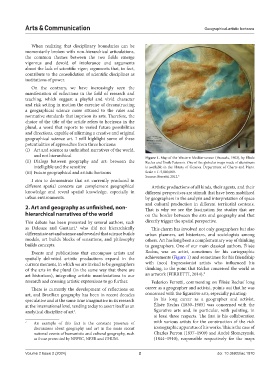
               and not hierarchical                            Figure 1. Map of the Western Mediterranean (Brussels, 1903), by Élisée
            (ii)  Dialogs between geography and art: between the   Reclus and Émile Patesson. One of the globular maps made of aluminum
               intelligible and the sensitive                  is available in the library of Geneva. Department of Charts and Plans.
            (iii) Future geographical and artistic horizons    Scale = 1: 5,000,000.
                                                               Source: Ferretti, 2012. 4
              I aim to demonstrate that art currently produced in
            different  spatial  contexts  can  complement  geographical   Artistic productions of all kinds, their agents, and their
            knowledge and reveal spatial knowledge, especially in   different perspectives are stimuli that have been mobilized
            urban environments.                                by geographers in the analysis and interpretation of space
                                                               and cultural production in different territorial contexts.
            2. Art and geography as unfinished, non-           That is why we see the fascination for studies that are
            hierarchical narratives of the world               on the border between the arts and geography and that
            This debate has been presented by several authors, such   directly trigger the spatial perspective.
            as Deleuze and Guattari,  who did not hierarchically   This charm has involved not only geographers but also
                                 1
            differentiate art and science and revealed that science builds   urban planners, art historians, and sociologists among
            models, art builds blocks of sensations, and philosophy   others. Art has long been a complementary way of thinking
            builds concepts.                                   to geographers. One of our main classical authors, Élisée
              Events and publications that encompass artists and   Reclus, was an artist, sometimes for his cartographic
            spatially delimited artistic productions expand in the   achievements (Figure 1) and sometimes for his friendship
            current moment, in which we are invited to be geographers   with (neo) Impressionist artists who influenced his
            of the arts in the plural (in the same way that there are   thinking, to the point that Réclus conceived the world as
            art historians), integrating artistic manifestations in our   an artwork (FERRETTI, 2014). 2
            research and crossing artistic expressions to go further.  Federico Ferretti, commenting on Élisée Reclus’ long
              There is currently the development of reflections on   career as a geographer and activist, points out that he was
            art, and Brazilian geography has been in recent decades   concerned with the figurative arts, especially painting:
            speculative and at the same time imaginative in its research      In  his  long  career  as  a geographer  and  activist,
            at the international level, tending today to assert itself as an   Élisée Reclus (1830–1905) was concerned with the
            analytical discipline of art .                        figurative  arts  and,  in  particular,  with  painting,  in
                                1
                                                                  at least three respects. The first is his collaboration
            1    An example of this fact is the constant presence of   with various artists for the construction of the rich
               discussions about geography and art in the main recent   iconographic apparatus of his works. This is the case of
               national events of humanistic and cultural geography, such   Charles Perron (1837–1909) and André Słomczynski
               as those promoted by NEPEC, NEER and GHUM.         (1844–1910), responsible respectively for the maps


            Volume 2 Issue 2 (2024)                         2                                doi: 10.36922/ac.1870

