


Page 32 - AC-2-2
P. 32
Arts & Communication                                                          Identification of Pollock Art


                                                               shows that the attempts to produce drip paintings similar to
                                                               Pollock’s style were successful in mimicking the overall hue
                                                               distribution in the paintings. It can also mean that Pollock’s
                                                               paintings do not reflect any unique signature style through
                                                               the overall hue distribution.
                                                                 Analysis of textures such as Gabor, Haralick, and Tamura
                                                               also shows significant differences between authentic
                                                               painting of Jackson Pollock and the faked paintings. The
                                                               mean Tamura texture directionality  measured from the
                                                                                            35
                                                               genuine Pollock paintings is 1.81 ± 0.02, while the same
                                                               directionality is 1.49 ± 0.02 when measured from the faked
                                                               Pollock paintings.  The t-value  of  the  difference  is  12.73,
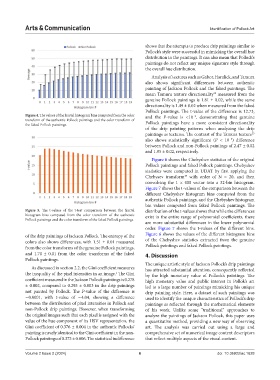
            Figure 4. The values of the fractal histogram bins computed from the color   and  the  P-value  is  <10 ,  demonstrating  that  genuine
                                                                                   −5
            transform of the authentic Pollock paintings and the color transform of   Pollock paintings have a more consistent directionality
            the faked Pollock paintings.
                                                               of the drip painting patterns when analyzing the drip
                                                                                                            35
                                                               paintings as textures. The contrast of the Tamura texture
                                                               also shows statistically significant (P <  10 ) difference
                                                                                                   −5
                                                               between Pollock and non-Pollock paintings of 2.47 ± 0.02
                                                               and 1.95 ± 0.02, respectively.
                                                                 Figure 6 shows the Chebyshev statistics of the original
                                                               Pollock paintings and faked Pollock paintings. Chebyshev
                                                               statistics were computed in UDAT by first applying the
                                                               Chebysev transform  with order of N = 20, and then
                                                                               19
                                                               convolving the 1 × 400 vector into a 32-bin histogram.
                                                               Figure 7 shows the t-values of the comparison between the
                                                               different Chebyshev histogram bins computed from the
                                                               authentic Pollock paintings, and the Chebyshev histogram
                                                               bin values computed from faked Pollock paintings. The
            Figure  5. The t-values of the t-test comparison between the fractal   distribution of the t-values shows that while the differences
            histogram bins computed from the color transform of the authentic   exist in the entire range of polynomial coefficients, there
            Pollock paintings and the color transform of the faked Pollock paintings.
                                                               are more substantial differences in the lower polynomial
                                                               order.  Figure  7 shows the t-values  of the different bins.
            of the drip paintings of Jackson Pollock. The entropy of the   Figure 6 shows the values of the different histogram bins
            colors also shows differences, with 1.51 ± 0.01 measured   of the Chebyshev statistics extracted from the genuine
            from the color transforms of the genuine Pollock paintings,   Pollock paintings and faked Pollock paintings.
            and 1.70 ± 0.01 from the color transforms of the faked   4. Discussion
            Pollock paintings.
                                                               The unique artistic style of Jackson Pollock’s drip paintings
              As discussed in section 2.2, the Gini coefficient measures   has attracted substantial attention, consequently reflected
            the inequality of the pixel intensities in an image.  The Gini   by the high monetary value of Pollock’s paintings. The
                                                  1
            coefficient measured in the Jackson Pollock paintings is 0.278   high monetary value and public interest in Pollok’s art
            ± 0.002, compared to 0.293 ± 0.003 in the drip paintings   led to a large number of paintings mimicking his unique
            not  painted  by  Pollock.  The  P-value  of  the  difference  is   drip painting style. Here, a dataset of such paintings was
            ∼0.0001, with t-value of  ∼4.04, showing a difference   used to identify the unique characteristics of Pollock’s drip
            between the distribution of pixel intensities in Pollock and   paintings as reflected through the mathematical elements
            non-Pollock drip paintings. However, when transforming   of his work. Unlike some “traditional” approaches to
            the original images such that each pixel is assigned with the   analyze the paintings of Jackson Pollock, this paper uses
            value of the hue component of its HSV representation, the   a quantitative method, providing a new way of observing
            Gini coefficient of 0.376 ± 0.004 in the authentic Pollocks’   art. The analysis was carried out using a large and
            painting is nearly identical to the Gini coefficient in the non-  comprehensive set of numerical image content descriptors
            Pollock paintings of 0.373 ± 0.006. The statistical indifference   that reflect multiple aspects of the visual content.


            Volume 2 Issue 2 (2024)                         6                                 doi: 10.36922/ac.1628

