


Page 29 - AC-2-2
P. 29
Arts & Communication                                                           Identification of Pollock Art


            authentic paintings by Pollock. Previous cases showed that   That transformation ensures that the colors analyzed by
            paintings claimed to be authentic Pollock’s paintings were   the way they are perceived by the human eye, rather than
            often not provided with strong evidence of authenticity, or   by triplets of RGB values that follow the way computer
            were shown to use painting materials that only existed after   hardware works, but do not always reflect the way colors
            the alleged date of creation.  As the results of this paper   are perceived by the human brain.
                                  23
            show, these paintings  also have  substantial  differences   In addition to the features in the WND-CHARM
            from Jackson Pollock’s paintings.                  feature set, UDAT also uses the Gini coefficient,  which
                                                                                                       37
              A dataset of drip paintings not created by Pollock was   was adopted from the field of economy to measure the
                                                                                          37
            also used in a previous study.  However, these paintings   distribution of light in an image.  The Gini coefficient is
                                    23
            were not presented by their owners as authentic Pollock   measured as the area under the curve of the histogram
            art. These paintings were created to provide drip paintings   of pixel intensities, which reflects the inequality of the
            inspired by Jackson Pollock and were used for decorative   intensities. Another visual measurement that was added is
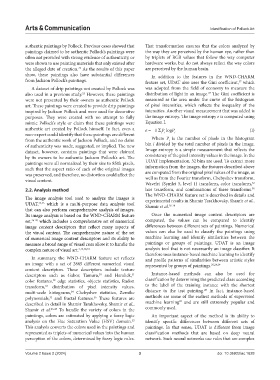
            purposes. They were created with no attempt to fully   the image entropy. The image entropy e is computed using
            mimic Pollock’s style or claim that these paintings were   Equation I.
            authentic art created by Pollock himself. In fact, even a   e = −1 Σ P  logP                   (I)
            non-expert could identify that these paintings are different   i i  i
            from the authentic work of Jackson Pollock, and no claim   Where P is the number of pixels in the histogram
                                                                         i
            of authenticity was made, suggested, or implied. The new   bin i divided by the total number of pixels in the image.
            dataset, however, contains paintings that were claimed   Image entropy is a simple measurement that reflects the
            by its owners to be authentic Jackson Pollock’s art. The   consistency of the pixel intensity values in the image. In the
            paintings were all normalized by their size to 850k pixels,   UDAT implementation, 32 bins are used. To extract more
            such that the aspect ratio of each of the original images   information from the images, the features described above
            was preserved, and therefore, no distortion could affect the   are computed from the original pixel values of the image, as
            visual content.                                    well as from the Fourier transform, Chebyshev transform,
                                                               Wavelet (Symlet 5, level 1) transform, color transform,
                                                                                                            32
                                                                                                            38
            2.2. Analysis method                               hue transform, and combinations of these transforms.
                                                               The WND-CHARM feature set is described in details and
            The image analysis tool used to analyze the images is   experimental results in Shamir Tarakhovsky, Shamir et al.,
            UDAT, 24,25  which is a multi-purpose data analysis tool   Shamir et al. 26-28
            that can also perform comprehensive analysis of images.
            Its image analysis is based on the WND-CHARM feature   Once the numerical image content descriptors are
            set, 26-28  which includes a comprehensive set of numerical   computed, the values can be compared to identify
            image content descriptors that reflect many aspects of   differences between different sets of paintings. Numerical
            the visual content. The comprehensive nature of the set   values can also be used to classify the paintings using
            of numerical image content descriptors and its ability to   machine learning and identify similarities between the
            measure a broad range of visual cues allow it to handle the   paintings or groups of paintings. UDAT is an image
            complex nature of visual art. 2,13,28,29           analysis tool that is not necessarily an image classifier. It
                                                               therefore uses instance-based machine learning to identify
              In summary, the WND-CHARM feature set reflects   and profile patterns of similarities between artistic styles
            an image with a set of 2885 different numerical visual   represented by groups of paintings. 25,28,29
            content descriptors. These descriptors include texture
            descriptors such as Gabor, Tamura,  and Haralick,    Instance-based methods can also be used for
                                           30
                                                         31
                       32
            color features,  edge statistics, objects statistics, Radon   classification by determining the predicted class according
            transform,  distribution of pixel intensity values,   to the  label of the training instance with the shortest
                    33
                                                                                        28
            multi-scale histograms,  Chebyshev statistics, Zernike   distance to the test painting.  In fact, instance-based
                               34
            polynomials,  and fractal features.  These features are   methods are some of the earliest methods of supervised
                      35
                                         36
                                                                             39
            described in detail in Shamir Tarakhovsky, Shamir et al.,   machine learning  and are still extremely popular and
            Shamir  et al. 26-28   To  handle  the variety of  colors  in the   commonly used.
            paintings, colors are estimated by applying a fuzzy logic   An important aspect of the method is its ability to
            analysis on the Hue Saturation Value (HSV) domain.    identify specific  differences  between different  sets of
                                                         32
            This analysis converts the colors used in the paintings and   paintings. In that sense, UDAT is different from image
            represented as triplets of numerical values into the human   classification methods that are based on deep neural
            perception of the colors, determined by fuzzy logic rules.   network. Such neural networks use rules that are complex
            Volume 2 Issue 2 (2024)                         3                                 doi: 10.36922/ac.1628

