


Page 31 - AC-2-2
P. 31
Arts & Communication                                                           Identification of Pollock Art


            Table 2. Combined Fisher discriminant scores of different image numerical content descriptors and different image transforms
                          Zernike     Chebishev   First 4   Multi‑scale  Haralick   Tamura    Radon    Fractals
                        Polynomials   Statistics  Moments   Histograms   Textures  Textures
            Raw pixels     2.94         1.40       2.89        3.11       2.69       0.90      0.44      1.7
            Color          3.288        1.05       2.18        2.42       4.58       0.67      0.46      8.9
            Hue            1.86         0.48       1.71        1.81       2.42       0.12      0.39      3.43
            Fourier        2.29         1.72       2.14        0.64       1.51       0.76      0.65      0.60
            Wavelet        3.81         1.23       1.06        3.25       5.42       0.23      0.78      0.06
            Chebyshev      0.16         3.52       1.59        2.38        2.7       0.59      0.28      1.06


            from different transforms of the paintings. As explained in
            section 2.2, a higher Fisher discriminant score means that
            the numerical content descriptor can better differentiate
            between authentic Jackson Pollock paintings and paintings
            by unknown painters who tried to mimic his work.
              The table shows that when computing numerical image
            content  descriptors from  the  raw  pixels  of  the images,
            fractal features are not among the most informative features
            that differentiate between authentic and faked Jackson
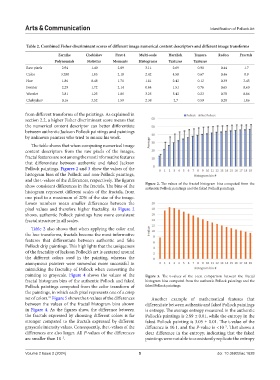
            Pollock paintings. Figures 2 and 3 show the values of the
            histogram bins of the Pollock and non-Pollock paintings,
            and the t-values of the differences, respectively. The figures
            show consistent differences in the fractals. The bins of the   Figure 2. The values of the fractal histogram bins computed from the
                                                               authentic Pollock paintings and the faked Pollock paintings.
            histogram represent different scales of the fractals, from
            one pixel to a maximum of 20% of the size of the image.
            Lower numbers mean smaller differences between the
            pixel values and therefore higher fractality. As  Figure  2
            shows, authentic Pollock paintings have more consistent
            fractal structure in all scales.
              Table 2 also shows that when applying the color and
            the hue transforms, fractals become the most informative
            features that differentiate between authentic and fake
            Pollock drip paintings. This highlights that the uniqueness
            of the fractality of Jackson Pollock’s art is centered around
            the different colors used in the painting, whereas the
            anonymous painters were somewhat more successful in
            mimicking the fractality of Pollock when converting the
            painting to grayscale.  Figure  4 shows the values of the   Figure  3. The t-values of the t-test comparison between the fractal
            fractal histogram bins of the authentic Pollock and faked   histogram bins computed from the authentic Pollock paintings and the
            Pollock paintings computed from the color transform of   faked Pollock paintings.
            the paintings, in which each pixel represents one of a crisp
            set of colors.  Figure 5 shows the t-values of the differences   Another  example  of  mathematical  features  that
                      21
            between the values of the fractal histogram bins shown   differentiate between authentic and faked Pollock paintings
            in Figure 4. As the figures show, the difference between   is entropy. The average entropy measured in the authentic
            the fractals expressed by choosing different colors is far   Pollock’s paintings is 2.89 ± 0.01, while the entropy in the
            stronger compared to the fractals expressed by different   faked Pollock painting is 3.05 ± 0.01. The t-value of the
            grayscale intensity values. Consequently, the t-values of the   difference is 10.1, and the P-value is <10 . That shows a
                                                                                                −5
            differences are also larger. All P-values of the differences   clear difference in the entropy, indicating that the faked
            are smaller than 10 .                              paintings were not able to consistently replicate the entropy
                           −5

            Volume 2 Issue 2 (2024)                         5                                 doi: 10.36922/ac.1628

