


Page 27 - AIH-1-1
P. 27
Artificial Intelligence in Health                                                        NLP in EHR


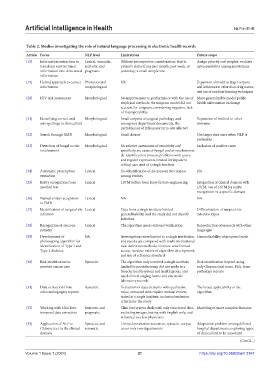
            Table 2. Studies investigating the role of natural language processing in electronic health records
            Article Focus            NLP level      Limitations                      Future scope
            [15]  Information extraction to   Lexical, semantic,   Without retrospective consideration, that is,   Assign priority and weights; evaluate
                  transform unstructured   syntactic and   patient’s status from past month, past week, or   interoperability among institutions
                  information into structured  pragmatic  yesterday; a small sample size
                  information
            [19]  Hybrid approach to extract  Phonetics and   NA                     Expansion of model to larger corpora
                  information        morphological                                   and information other than drug names
                                                                                     and use of machine learning techniques
            [20]  HIV risk assessment  Morphological  No improvement in performance with the use of  More generalizable model public
                                                    empirical methods; the unigram model did not   health information exchange
                                                    account for unigram, considering negation, lack
                                                    of interoperability
            [21]  Identifying correct and   Morphological  Small corpora of surgical pathology and   Expansion of method to other
                  mis-spellings in clinical text    emergency department documents, the   domains
                                                    performance of infrequent term sets affected
            [22]  Search through EMR  Morphological  Small dataset                   Use larger data sizes when NLP is
                                                                                     preferable
            [23]  Detection of fungal ocular   Morphological  No relative assessment of sensitivity and   Inclusion of positive cases
                  involvement                       specificity, no cases of fungal ocular involvement,
                                                    de-identification process, problems with query
                                                    and regular expression, limited for inpatient
                                                    critical care unit of a single institute
            [24]  Automatic prescription   Lexical  De-identification of documents the relation   NA
                  extraction                        among entities
            [25]  Entity recognition from   Lexical  LSTM suffers from fussy feature engineering  Integration of clinical domain with
                  medical text                                                       LSTM, use of LSTM for entity
                                                                                     recognition in a specific domain
            [26]  Named entity recognition   Lexical  NA                             NA
                  in EMR
            [27]  Identification of surgical site  Lexical  Data from a single institute limited   Differentiation of surgical site
                  infection                         generalizability, and the study did not classify   infection types
                                                    infection
            [28]  Recognition of syncope   Lexical  The algorithm needs external verification  Reproduction of research with other
                  patients                                                           languages
            [29]  Development of     NA             Investigations were limited to a single institution,  Generalizability of proposed work
                  phenotyping algorithm for         and results are compared with multi-institutional
                  identification of Type 1 and      case definition methods, institute-wise limited
                  Type 2 diabetes                   access, iterative nature of algorithm development,
                                                    and use of reference standard
            [30]  Risk stratification in   Syntactic  The algorithm only involved a single institute,   Risk stratification beyond using
                  prostate cancer care              limited to prostatectomy, did not apply to a   only Gleason total score, PSA, from
                                                    broader health system and health group, and   pathology reports
                                                    used clinical staging forms and electronic
                                                    laboratory records
            [31]  Data extraction from   Semantic   Extraction of data elements with qualitative   The broad applicability of the
                  echocardiography reports          value, extracted data require manual review,   algorithm
                                                    tested at a single institute, inclusion/exclusion
                                                    criteria for the study
            [32]  Working with CliniText,   Semantic and   CliniText system deals with only structured data,  Modeling of more complex domains
                  temporal data extraction  pragmatic  excluding images, testing with English only, and
                                                    is limited to a few physicians
            [33]  Application of NLP to   Syntactic and   Limited annotation resources, syntactic corpus   Adaptation problem among differed
                  Chinese text in the clinical   semantic  cover only two departments  hospital departments, exploring types
                  domain                                                             of clinical text to be annotated
                                                                                                       (Cont’d...)

            Volume 1 Issue 1 (2024)                         21                        https://doi.org/10.36922/aih.2147

