


Page 29 - AIH-1-1
P. 29
Artificial Intelligence in Health                                                        NLP in EHR


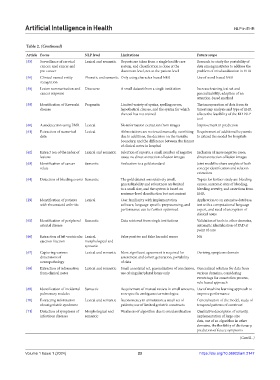
            Table 2. (Continued)
            Article Focus            NLP level      Limitations                      Future scope
            [55]  Surveillance of cervical   Lexical and semantic  Reports are taken from a single health-care   Research to study the portability of
                  cancer: anal cancer and           system, and classification is done at the   data among institutes to address the
                  pre-cancer                        document level, not at the patient level  problem of misclassification in EHR
            [56]  Clinical named entity   Phonetic and semantic Only using character-based NER  Use of word-based NER
                  recognition
            [58]  Lesion summarization and  Discourse   A small dataset from a single institution  Increase training test set and
                  cancer response                                                    generalizability; adoption of an
                                                                                     attention-based method
            [59]  Identification of Kawasaki   Pragmatic   Limited variety of syntax, spelling errors,   The incorporation of data from its
                  disease                           hypothetical clauses, and the syntax for which   timestamp analysis and type of EHR
                                                    the tool has not trained         affects the feasibility of the KD-NLP
                                                                                     tool
            [60]  Autodetection using EMR  Lexical  No information extraction from images  Improvement in prediction
            [61]  Extraction of numerical   Lexical  Abbreviations are reviewed manually, overfitting  Requirement of additional keywords
                  data                              due to additions, the decision on the variable   to extend the model for hospitals
                                                    boundary, and the difference between the format
                                                    of clinical notes in hospital
            [62]  Extract ion of the index of   Lexical and semantic  Selection of reports, a small number of negative   Inclusion of more negative cases,
                  lesions                           cases, no direct extraction of lesion images  direct extraction of lesion images
            [63]  Identification of cancer   Semantic  Evaluation to a gold standard  Joint model to share weights of both
                  relate                                                             concept identification and relation
                                                                                     extraction
            [64]  Detection of bleeding events Semantic  The gold dataset was relatively small,   Topics for further study are bleeding
                                                    generalizability and robustness are limited   causes, anatomic sites of bleeding,
                                                    to a small size, and the system is based on   bleeding severity, and assertions from
                                                    sentence-level classification but not context  EHR.
            [29]  Identification of patients   Lexical  User familiarity with implementation   Application to an extensive database,
                  with rheumatoid arthritis         software, language-specific preprocessing, and   test with a computational language
                                                    performance can be further optimized  expert, and need of encryption of
                                                                                     clinical notes
            [65]  Identification of peripheral  Semantic  Data retrieved from single institutions  Validation of tools in other domains,
                  arterial disease                                                   automatic identification of PAD at
                                                                                     point of care
            [66]  Extraction of left ventricular  Lexical,   False positive and false harmful errors  NA
                  ejection fraction  morphological and
                                     syntactic
            [67]  Capturing various   Lexical and semantic  More significant agreement is required for   Deriving symptoms domain
                  dimensions of                     assessment and cohort generation, portability
                  neuropathology                    of data
            [68]  Extraction of information   Lexical and semantic  Small annotated set, generalization of conclusion,  Generalized solution for data from
                  from clinical notes               use of singular/plural forms only  various domains, considering
                                                                                     events tags for annotation process,
                                                                                     rule-based approach
            [69]  Identification of incidental   Syntactic  Requirement of manual review in small amounts,  Use of machine learning approach to
                  pulmonary nodules                 non-specific ambiguous terminologies  improve performance
            [70]  Extracting information   Lexical and semantic  Inconsistency in annotation; a small set of   Generalization of the model, study of
                  about geriatric syndrome          patients; use of limited geriatric constructs  temporal patterns of construct
            [71]  Detection of symptoms of   Morphological and   Weakness of algorithm due to misclassification  Qualitative description of severity,
                  infectious diseases  semantic                                      implementation of large-size
                                                                                     data, use of an algorithm in other
                                                                                     domains, the flexibility of dictionary,
                                                                                     prediction of future symptoms
                                                                                                       (Cont’d...)


            Volume 1 Issue 1 (2024)                         23                        https://doi.org/10.36922/aih.2147

